Beresheet: The Tardigrades Stranded on the Moon
The failed 2019 landing of an Israeli spacecraft has reignited questions about the survival of Earth's most resilient organisms in the vacuum of space.
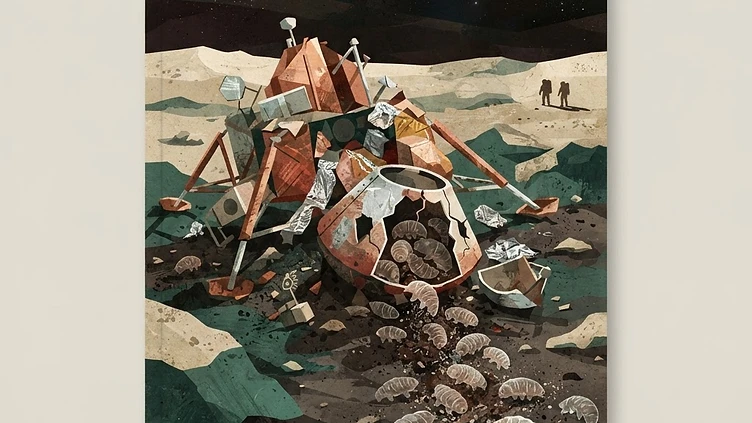
If you wanted to send a letter to the Moon, what would you put inside? In the spring of 2019, Israel's space program, SpaceIL, turned this question into a practical matter by sending a small spacecraft named Beresheet to the lunar surface. The craft lost control in the final meters of its descent, crashed, and was recorded in news bulletins as a failed mission. Yet, the most intriguing part of the story lies in what was aboard the wreckage. Beresheet carried more than just metal and fuel; it held a piece of human history and specimens of the creature that has come closest to immortality. This crash transformed from a technical failure report into a philosophical inquiry: Can life be transported from one place to another under the harshest conditions, and if so, who bears the responsibility? ## The Secret Library of the Arch Mission Inside the hull of Beresheet lay an object that looked like an ordinary disc but was actually a concentrated summary of human history. The Arch Mission Foundation, which prepared this disc, had a clear purpose: to transport human knowledge, language, and perhaps our biological signature beyond Earth. The disc contained a vast portion of Wikipedia, thousands of books, digital archives, and human DNA samples. It felt less like a time capsule and more like an insurance policy; as if humanity were harboring doubts about its own future and trying to alleviate them by burying these remnants on the Moon. One must stop and ask: Should a spacecraft's mission not be its primary objective? Beresheet's official goal was a soft landing on the lunar surface, but this side mission, carried in the pockets of engineers, was too significant to be overshadowed. Sending a library to the Moon was not just a technical achievement but a declaration: humanity can leave its story and proof of existence elsewhere as a backup against Earth's fragility. When Beresheet crashed, this claim remained under the wreckage, but the idea did not; on the contrary, the mission's failure made the concept even more widely discussed. ## The Tardigrades' Immortality Trick Hidden within the Arch Mission disc was more than just data. Thousands of tardigrades, tiny invertebrates also known as water bears, were dehydrated and encased in resin in a corner of this library. Tardigrades possess a feature that has become almost legendary in biology: the ability to enter a state of suspended animation known as cryptobiosis. In this state, their metabolism drops to near zero, their body water is largely depleted, and the creature exists in a state of suspended life. This allows them to wait for years, even in a vacuum, under extreme radiation, or at temperatures far below freezing. This resilience transcends scientific curiosity and becomes a thought experiment. If an organism can remain indifferent to Earth's most extreme conditions, could it gaze upon the vacuum of space with equal indifference? Whether the tardigrades survived the Beresheet crash is still debated, as the impact's force and heat may have exceeded the durability limits tested in laboratory conditions. Yet, the question itself tells us more than the answer: the portability of life in interplanetary travel is now a concern not only for science fiction writers but also for planetary protection experts. ## How Was the Planetary Protection Principle Breached? A second layer emerges here. International space law, particularly the Outer Space Treaty of 1967, mandates that celestial bodies must not be contaminated with organisms originating from Earth. This principle is known as the planetary protection protocol, and its goal is simple: if we ever find signs of indigenous life on the Moon or Mars, we must be certain it is not a microbe or tardigrade that we brought with us. While these protocols were supposedly reviewed during the approval of the Beresheet mission, the presence of the tardigrades was only disclosed after the crash. This delay was a small but significant example of how loosely these protocols can be applied in practice. How can such a vital principle be bypassed so easily? The answer lies in the inadequacy of oversight mechanisms, as is the case with many international regulations. States and private ventures do not rely on an independent authority to monitor space payloads but largely on self-declaration. The Arch Mission Foundation's inclusion of this disc was an add-on load, largely outside the scope of SpaceIL's official mission plan. This situation reveals that the principle of planetary protection is strong on paper but fragile in practice. Beresheet's crash was perhaps the first real case to test this fragility, and it now stands as a warning sign for future missions. The curious aspect is the shift in the debate within the scientific community following this event. Some experts argue that the chance of the tardigrades surviving on the lunar surface is low, as the heat and pressure of the impact might have exceeded even the limits of cryptobiosis. Others argue that this very uncertainty is a risk: having irreversibly transported something to another celestial body that we are not sure about violates the most basic principle of scientific caution. The tension between these two views is a reflection of a larger pattern where humanity finds itself trapped between its curiosity and its responsibility. The wreckage of Beresheet lies silently on the dusty surface of the Moon today, perhaps with tardigrades still waiting in cryptobiosis, or perhaps with a library that no longer retains any trace. Yet, this incident has shown us that space exploration is a domain where not only engineering success but also biological and ethical responsibility are tested. One day, when we encounter true signs of life on Mars or an icy moon, we will want to know if those traces are something we brought ourselves. The story of Beresheet reminds us that we need to ask that question now; because it is not just the tardigrades that push the limits of life, but we ourselves who attempt to carry it.
İlgili Denemeler
Can the Human Brain Detect Magnetic Fields?
Geophysicist Joseph Kirschvink's experiment at Caltech indicates that the human brain responds to magnetic fields, raising questions about a potential sixth sense.
Jan Hendrik Schön: The Physicist Who Fooled Science
The scandal of Jan Hendrik Schön's fabricated data at Bell Labs highlights the critical vulnerabilities in the scientific peer-review system.
Barry Marshall Drank Bacteria to Prove Stomach Ulcer Theory
Barry Marshall made medical history by consuming harmful bacteria to prove that stomach ulcers are caused by an infection rather than stress alone.
Tartışma (0)
Henüz yorum yok. İlk yorumu siz yapın.
Join the Newsletter
New essays, once a week, delivered to your inbox.