Benford's Law: How Math Detects Fraud in Numbers
From nature to tax returns, why does the first digit of numbers always follow the same strange pattern?
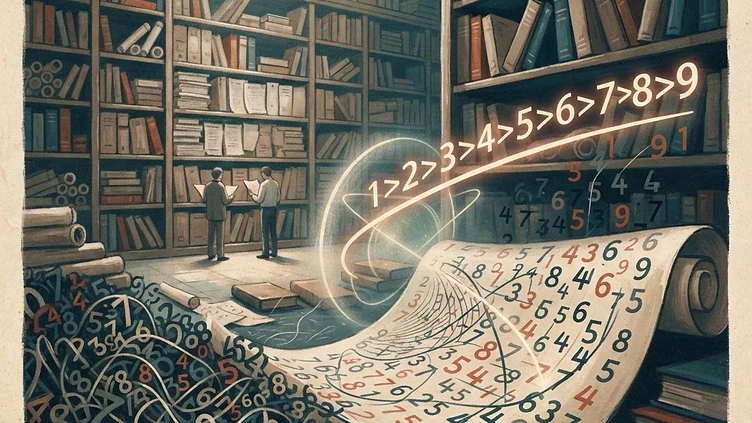
Looking at a sequence of numbers and searching for a hidden order might seem absurd at first glance. Numbers are random, are they not? The population of a city, a company's expense items, or the length of a river are independent events, and establishing a mathematical link between them sounds like overly optimistic numerology. However, at the beginning of the twentieth century, an astronomer and later an engineer realized that this intuition was wrong. The first pages of the logarithm tables they possessed were much more worn than the last ones. That is, people were searching for numbers starting with one more frequently than those starting with nine. This small, almost anecdotal observation has evolved into a tool that today uncovers fake invoices, inflated balance sheets, and manipulated election results. So how is this possible; has the universe itself established a defense mechanism against fraud?
The Hidden Pattern of Numbers
The essence of Benford's Law can be summarized in a surprisingly simple sentence: in natural and financial data, if the first digit of a number is one, it is much more likely to occur than it is to be a nine. When you choose a random number, you would expect every digit to appear with equal probability, just as each side of a die should come up one-sixth of the time. But in large datasets collected from the real world, things do not work that way. Numbers starting with one appear nearly one-third of the time, while those starting with nine barely reach five percent. This distribution is not random; it is strictly tied to a logarithmic curve. As numbers grow, they stay at a certain digit for longer before adding another. A company's revenue must grow by one hundred percent to go from one thousand to two thousand, but only eleven percent is needed to go from nine thousand to ten thousand. This asymmetry explains why numbers starting with one are so dominant.
The power of this pattern lies in its independence from any single dataset. From the lengths of rivers to stock market indices, from city populations to physical constants, the same distribution emerges repeatedly in completely unrelated fields. When one hears this for the first time, it might seem like a coincidence, but the mathematical proof is based on a property called scale invariance: no matter what units you measure the data in—meters or miles, liras or dollars—the distribution remains the same. This shows that the law is not a cosmic anomaly but a mathematical necessity hidden in the nature of growth and multiplicative processes. Thus, what we encounter is not a mysterious universal law, but a reflection of the inherent logic of numbers themselves.
The Mathematical Trail of Fraud
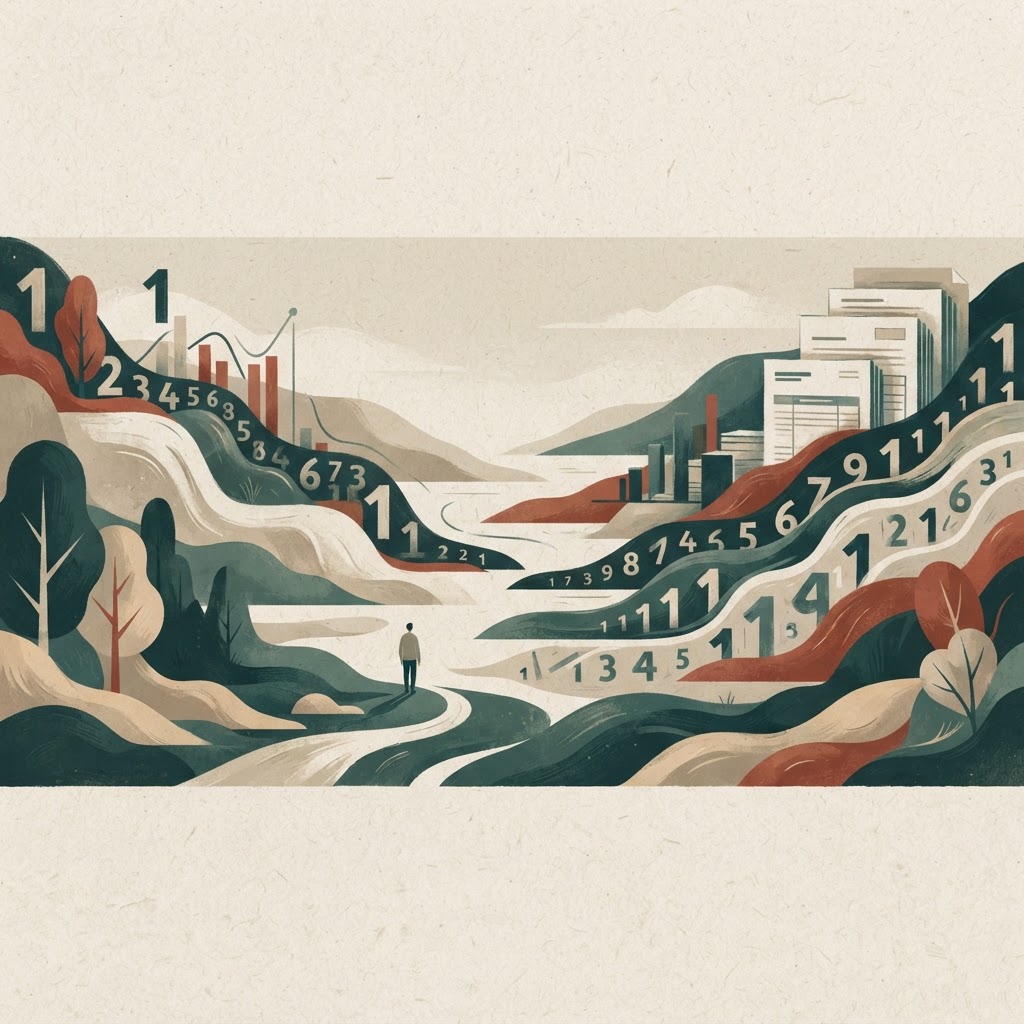
This is the point where auditors and forensic accountants take notice. Because when a person attempts to produce fake numbers, they unconsciously engage their own mental habits. Most people, when generating random numbers, prefer digits in the middle, avoid starting with extremely small or large numbers, and show a tendency to cluster in specific digits. Real data, independent of this human intuition, remains faithful to the logarithmic distribution. Therefore, comparing a company's expense records, tax returns, or accounting books with the Benford distribution makes it almost impossible for fraudulent entries to remain hidden without leaving a trace. The greater the deviation from the expected curve, the higher the probability that the numbers in that dataset were manufactured by human hands.
It should be noted that this method is not limited to financial reports. A similar logic is applied in the analysis of election results: if the vote distribution of a ballot box is the product of natural counting processes, it is expected to display a pattern close to the Benford distribution. Sudden and sharp deviations do not necessarily imply cheating, but they serve as a red flag that should attract the attention of researchers. The important point here is that the law is not a tool of accusation in itself; it acts more like a compass indicating which data needs to be examined more closely. When an auditor sees this deviation, they do not close the file; on the contrary, they open it, and the real investigation begins there.
The Fragile Limits of the Law
However, this mathematical elegance has a trap: it appears too reliable. Benford's Law is not a universal lie detector that can be applied to every set of numbers. Data determined by human hands that are not tied to multiplicative growth, such as phone numbers, zip codes, or student ID numbers in a class, do not fit this distribution at all. Similarly, number sets trapped within a specific range—such as the age distribution of a country's adult population—naturally deviate from the curve predicted by the law. In such cases, if an auditor blindly trusts the law and mistakes a deviation for fraud, they risk unfairly casting suspicion on a completely innocent dataset.
The real issue is remembering that Benford's Law is a clue, not evidence. Making an accusation in a courtroom based solely on this statistic would be confusing mathematical elegance with legal certainty. In small datasets, such as a ledger consisting of only a few hundred entries, even random fluctuations can produce significant deviations from the law; this increases the risk of confusing statistical noise with deliberate fraud. Therefore, the power of the method is directly proportional to keeping one's faith in it measured. Using the law as an initial filter or a guiding indicator offers a much healthier approach than seeing it as a final verdict.
The true magic of Benford's Law perhaps lies in its lack of attempt to prove anything. It merely shows how numbers behave when untouched by human hands; we use this behavior like a mirror to try and spot the hand that reaches out in front of it. While growth processes in nature, economic expansions, and even certain physical constants remain faithful to this silent logic, fake numbers produced by the human mind always betray this loyalty in some way. This reminds us that even the coldest, most technical-looking mathematical patterns can open a surprisingly human window into understanding the subtleties of human behavior. Perhaps that is why the worn pages of a logarithm table, even a century later, still teach us how to follow the trail of honesty.
İlgili Denemeler
Can the Human Brain Detect Magnetic Fields?
Geophysicist Joseph Kirschvink's experiment at Caltech indicates that the human brain responds to magnetic fields, raising questions about a potential sixth sense.
Jan Hendrik Schön: The Physicist Who Fooled Science
The scandal of Jan Hendrik Schön's fabricated data at Bell Labs highlights the critical vulnerabilities in the scientific peer-review system.
Barry Marshall Drank Bacteria to Prove Stomach Ulcer Theory
Barry Marshall made medical history by consuming harmful bacteria to prove that stomach ulcers are caused by an infection rather than stress alone.
Tartışma (0)
Henüz yorum yok. İlk yorumu siz yapın.
Join the Newsletter
New essays, once a week, delivered to your inbox.