Belyaev's Foxes: The Secret Domestication Experiment
How did a Soviet geneticist repeat millennia of evolution in just six decades by selecting foxes based on their trust in humans?
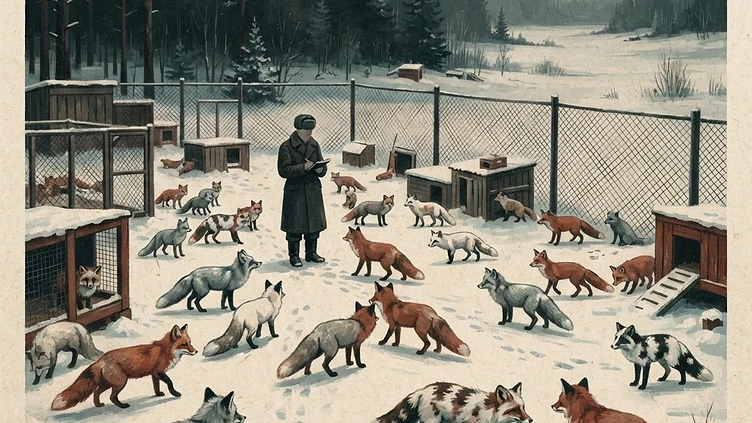
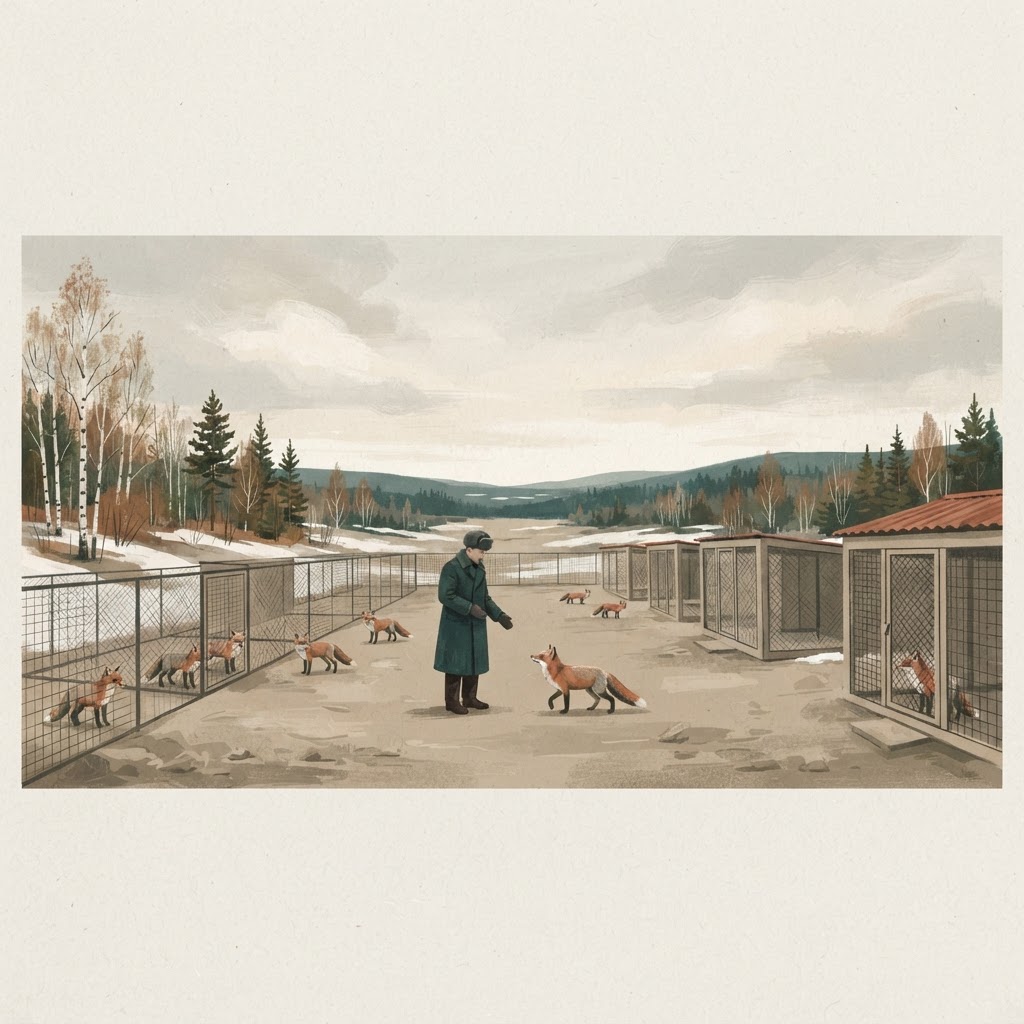
Consider the fleeting moment when a human catches the eye of an animal, and its wariness gives way to curiosity. Today, it seems so natural for a dog to jump into our laps or a cat to nap on our knees that we forget this is the result of thousands of years of patient evolution. But did this process really have to take millennia, or could nature orchestrate this transformation much faster? During one of the darkest periods for Soviet science, a secret experiment conducted in a remote corner of Siberia provided both a surprising and haunting answer: domestication could be a rapid chain reaction triggered by a single selection rather than a journey spanning thousands of years. ## A Geneticist's Rebellion in the Shadow of Stalin The era in which Dmitriy Belyaev worked was one of the most skeptical periods for Soviet science regarding genetics. Lysenko's official ideology posited that environment and labor, rather than genes, shaped living organisms, branding Mendel's genetics as a bourgeois heresy. In this climate, pursuing genetics was not just a scientific choice but a direct political risk; indeed, many of his colleagues lost their jobs, their freedom, and some their lives. Belyaev himself paid the price for this pressure by being removed from official institutions, but this did not stop him; on the contrary, he decided to continue his research under the cover of a fur animal breeding project. We must pause here to ask: is a scientist willing to risk their career and safety to find the answer to a question they believe in? Belyaev's answer was clear. By appearing to work on fox farms, he was actually testing one of the most fundamental questions of evolution: how behavior shapes the body. This was not just scientific curiosity; it was a silent but persistent resistance against ideological oppression. In a country where genetics was denied, he managed to produce one of the most striking proofs of genetics, all while keeping it hidden from the gaze of official science. ## Choosing Only Friendship Belyaev's experiment was remarkably simple. He took silver foxes and separated them based on a single criterion: their affinity toward humans. Foxes that fled, attacked, or were skittish were kept apart, while those that approached, allowed themselves to be touched, and remained calm near humans became the parents of the next generation. The only thing selected for was behavior; no physical characteristics were considered. Logically, one would expect the foxes to simply become tamer as generations passed, with nothing else changing. But that is not what happened. As generations progressed, changes appeared in the foxes' bodies that no one had selected for. Tails began to curl, ears became floppy, and white patches appeared in their fur; it was as if changing behavior were dragging the body along against its will. How could this be possible? The answer lies in the fact that evolution does not typically change one trait in isolation as we often imagine. The effect of a single gene or hormonal pathway can reach many different parts of the body simultaneously. The biological mechanism controlling tameness was part of a network that also affected cartilage development, pigment production, and even skull shape. Belyaev had inadvertently uncovered the invisible connections of evolution. This point, I believe, carries the true philosophical weight of the experiment. When we observe the domestication of a species in nature, we usually imagine it not as a conscious human choice, but as the accumulation of thousands of little coincidences. But Belyaev's foxes showed that evolution can be very economical: crossing a single behavioral threshold can drag the rest of the body along with it. This is perhaps not nature's laziness, but its intelligence; it found a way to touch a small number of buttons to change a large number of outcomes at once. ## The Domestication Syndrome and Shared Genetic Code These changes that appeared in the foxes had actually been seen elsewhere before: in dogs, pigs, and even cattle. Curled tails, floppy ears, mottled fur, and shortened snouts; this cluster of traits that recurs in almost every domesticated species has become known in scientific literature as the domestication syndrome. Belyaev's foxes held a unique position because they produced this syndrome step by step under laboratory conditions and observation over many generations. While we have to speculate when reading the history of dog domestication from thousands of years ago, the process in foxes happened right before our eyes, under record. This similarity was too strong to be seen as a mere coincidence. The fact that animals domesticated at different times, in different places, and from different species share the same physical traits indicated that a common developmental mechanism lay beneath. Researchers traced this commonality to specific groups of cells that migrate throughout the body in the very early stages of the embryo; these cells are thought to influence both the nervous system's stress response and the development of tissues such as cartilage and pigment. In other words, domestication was not a trick invented separately for each species, but the triggering of a shared biological potential that organisms already possessed. Perhaps it is worth remembering that humans are not exempt from this law either. We know that a similar trace of domestication is being sought in the evolutionary history of our own species; some researchers suggest that humans may be a self-domesticated species. If the domestication syndrome truly relies on such a universal mechanism, Belyaev's foxes cease to be just a story about a fur animal and start saying something about life itself. Looking back today, Belyaev's experiment shows us both how courageous science can be and how economical nature can be. Conducted under the pressure of an ideology and hidden from official science, this work repeated in six decades what evolution usually does in thousands of years, and in doing so, it reminded us of how deep and shared a biological possibility domestication actually is. Perhaps that first moment of trust between human and animal depends on far fewer coincidences and far more rules than we think; and tracing those rules brings us to the threshold of questions about how we ourselves were shaped.
İlgili Denemeler
Can the Human Brain Detect Magnetic Fields?
Geophysicist Joseph Kirschvink's experiment at Caltech indicates that the human brain responds to magnetic fields, raising questions about a potential sixth sense.
Jan Hendrik Schön: The Physicist Who Fooled Science
The scandal of Jan Hendrik Schön's fabricated data at Bell Labs highlights the critical vulnerabilities in the scientific peer-review system.
Barry Marshall Drank Bacteria to Prove Stomach Ulcer Theory
Barry Marshall made medical history by consuming harmful bacteria to prove that stomach ulcers are caused by an infection rather than stress alone.
Tartışma (0)
Henüz yorum yok. İlk yorumu siz yapın.
Join the Newsletter
New essays, once a week, delivered to your inbox.