The 1518 Dancing Plague: A Study of Mass Hysteria
In the summer of 1518, hundreds of people in the streets of Strasbourg danced for weeks without stopping, with some dying as a result.
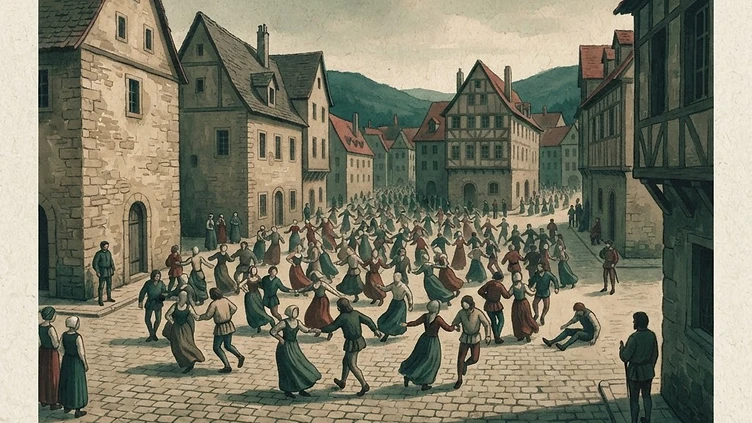
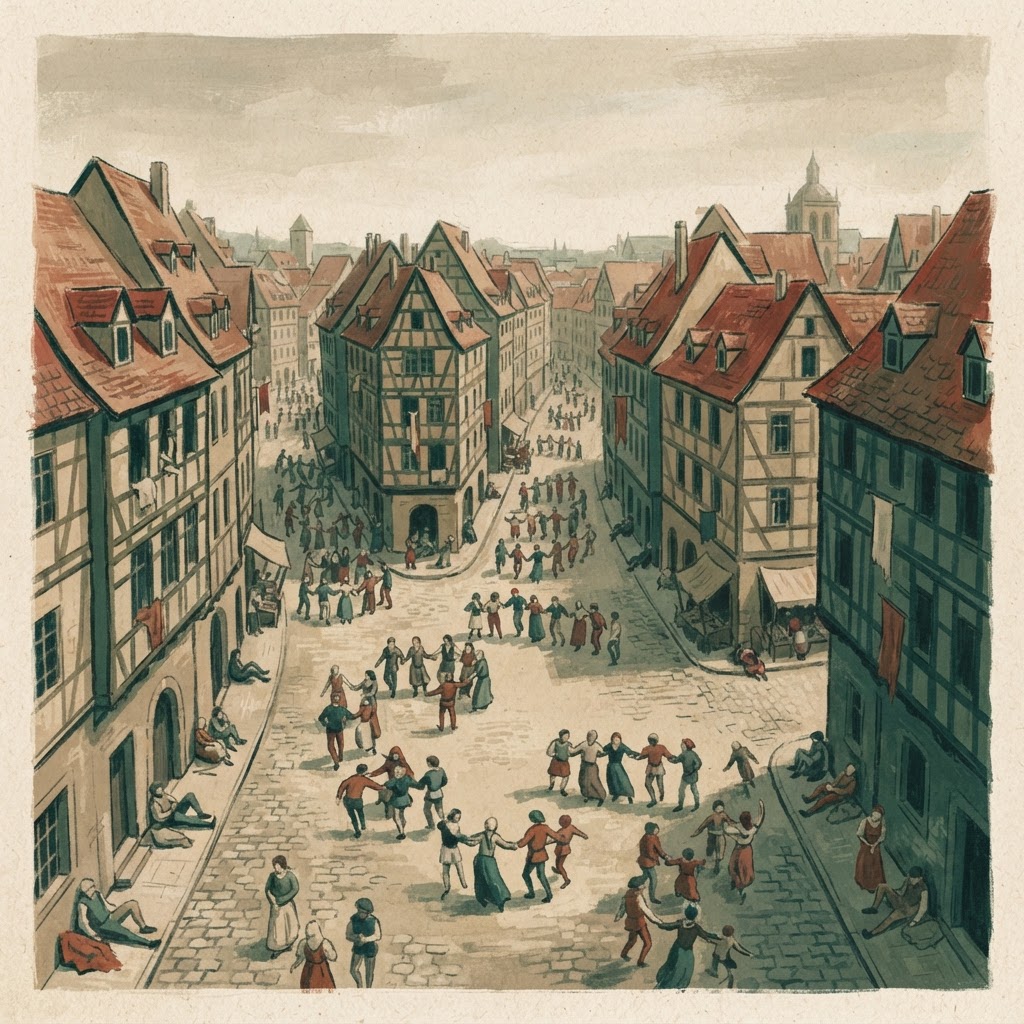
How can one explain a body dancing for days on end without showing any signs of mental illness? This is precisely what happened in the streets of Strasbourg in the summer of 1518: hundreds of people danced as if a never-ending music were playing within them, until their feet bled and their bodies collapsed. Some died in the midst of this frenzy. When we read this story today, we initially perceive it as a strange anecdote, perhaps a remnant of medieval ignorance. Yet, if we pause to reflect, we see not an individual deviation, but a profound tension erupting in the body of a society. That summer, the dancing bodies were actually articulating something they could not put into words. ## A Woman's Feet Never Stopped The story begins with a single woman. One July day, this woman, named Frau Troffea, emerged onto the narrow streets of Strasbourg and began to dance. There was no music, no celebration; only a body in perpetual motion. Her neighbors watched in confusion at first, then with unease; she continued dancing for hours, then days. The human mind cannot process such a scene alone; everyone who witnessed it was somehow drawn into that movement. As days passed, other bodies joined hers. First a few, then dozens, and finally hundreds of people were swept up in the same strange magnetism in the city squares and streets. The real question here is: Why is one person's peculiarity so easily contagious? Searching for the answer in individual psychology is misleading, for the issue is not the breakdown of a single mind. The Alsace region of that year housed a populace crushed under the weight of famine, fear of the plague, and heavy taxes. For people living on the edge of starvation, facing an uncertain future and surrounded by religious dread, the body became a language that intervened where words failed. Troffea's dance was merely a trigger; the tension fermenting beneath the surface had been there for months, perhaps years. The explosion of a collective crisis in an individual body, and the subsequent spread of that explosion to others, felt like the most striking confession of social agony. ## Doctors Amplified the Dance with Treatment When the city's officials and physicians encountered this strange epidemic, they clung to the medical understanding of the era. According to the prevailing theory of the four humors, illness arose when the balance of bodily fluids was disrupted; the condition of the dancers was attributed to an excess of hot blood. The proposed solution, though it may sound strange to the modern ear, was quite consistent within the logic of that time: if the body were expelling excess heat through dancing, then it was necessary to support, and even encourage, the dancing. The city prepared a special hall for the dancers, hired musicians, and even erected a platform so that people might exhaust themselves faster and recover. The result of this intervention was the exact opposite of what was intended. As music and space were provided, the dance drew in more people; the arrangement intended for treatment turned into a stage that effectively fueled the epidemic. Here we see how easily human reason can become trapped by its own assumptions. Can the physicians be blamed for acting on an incorrect theory? Perhaps not, for they tried to produce the most logical solution with the knowledge they possessed. But this effort reminds us: trying to provide a solution to a crisis without understanding it often feeds the crisis. That platform in the Strasbourg square was a concrete monument to the strange outcomes that can arise when good intentions meet poor diagnosis. Moreover, the church was not indifferent to this scene. Rumors circulated that the dance frenzy had to do with sin, curses, or divine punishment; some clergy led the dancers on pilgrimages to the shrines of saints, hoping a miracle would stop their bodies. But neither the medicine of music nor the prayers of religion immediately calmed the body, because the real ailmententententent was not in the body, but hidden in the social foundation that sustained it—a foundation that remained untouched. ## Mass Madness Never Ended When we look at the flow of social media today, do we not see something very similar to what occurred in the squares of Strasbourg? A piece of news, a video, a moment of panic leaps to millions of screens within minutes; people repeat the same fear, the same reaction, and sometimes the same strange behavior as if it were a contagion. Of course, the tools have changed; shared screenshots have replaced dancing bodies. But the essence of the mechanism remains the same: a social tension discharges not through individual reason, but through a collective wave of imitation. Thus, the dancing plague of Strasbourg is not just a strange footnote in history, but can be considered a very old ancestor of today's mass behaviors. Perhaps one might object: people of that era were ignorant, there was no science, whereas today we have access to reason and knowledge, so we would not fall prey to such a frenzy. But current examples do not particularly support this claim. As access to information has increased, mass panic has not decreased; it has merely changed form. This is because the issue is not a lack of information, but the search for a release valve by a community under pressure. The body takes action when words are insufficient; in the age of screens, fingers, posts, and shared fears become the new extensions of that body. The escape of human psychology under collective tension into the body, or its digital equivalent, is fed by the same human impulse, whether five hundred years ago or today. Dancing bodies were a language that began where words ended; while we think we have long forgotten that language today, we are actually just repeating it in a different form and at a different speed. The summer of Strasbourg reminds me of this: social tension accumulates somewhere, and that accumulation, whether it manifests in a woman's tireless feet or a screen's relentless feed, eventually finds a way out. Perhaps the real thing to fear is not the body rebelling, but the silence that births that rebellion going completely unnoticed.
İlgili Denemeler
The Mechanical Turk: History's Chess-Playing Mystery
The chess-playing automaton known as the Mechanical Turk deceived figures like Napoleon and Benjamin Franklin, masking a hidden human operator as a machine.
Bournville: The Utopian Town Built by Chocolate
The streets, gardens, and teetotal order of Bournville reveal how the Quaker faith imprinted a distinct form of morality upon the foundations of industry.
Levi's: The Story of Riveted Jeans Born from Gold Rush
In 1873, a tailor's discovery of a riveted solution for torn pockets redirected the true fortune of the gold rush toward the enduring garment industry.
Tartışma (0)
Henüz yorum yok. İlk yorumu siz yapın.
Join the Newsletter
New essays, once a week, delivered to your inbox.