The Etiquette of Not Staring: Protecting Public Space
Why do we always stare at the ceiling in a crowded elevator, and what does this silent agreement reveal to us?
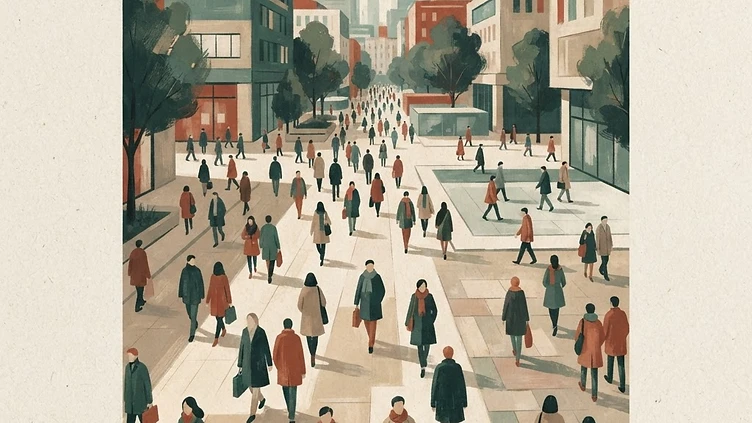
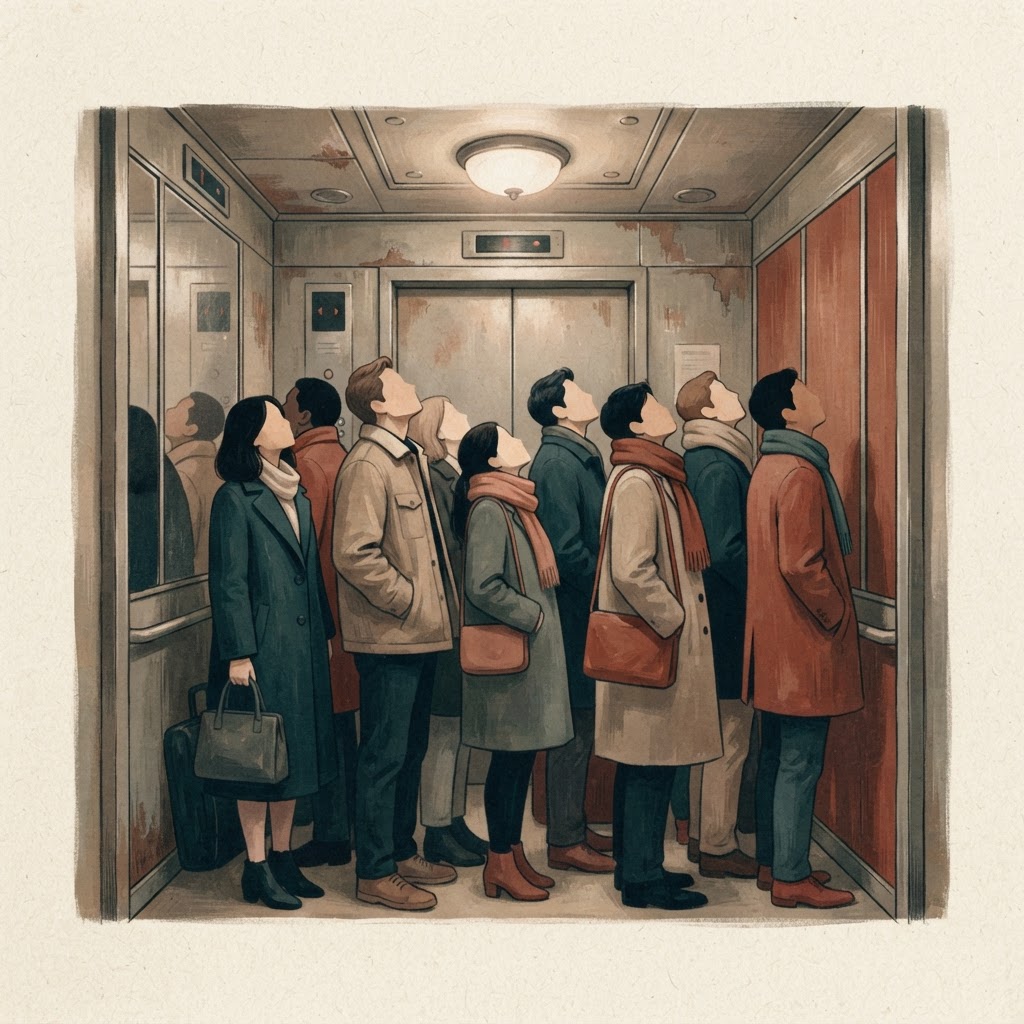
There is a small ritual I perform whenever I step into a crowded elevator: I press the button, and then my eyes automatically drift upward, as if there were a hidden script written on the ceiling that demands to be read. The stranger next to me does the same, looking at their phone or staring intently at the tips of their shoes. Nobody taught us this; it was never explained in a course, yet everyone performs the same silent choreography simultaneously. This strange harmony has always made me wonder: what does our expertise in ignoring each other actually tell us about human relationships? ## The Language of Ignoring Walking down a busy street, most of us quickly divert our gaze when we lock eyes with an oncoming stranger. It is easy to mistake this movement for rudeness, yet something quite the opposite is happening. As Erving Goffman pointed out, people exhibit a certain inattention toward one another in public spaces, but this inattention is not apathy; rather, it is a delicate effort to avoid intruding on the personal space of the other. Not letting someone know that we have noticed them is a way of ensuring they are not uncomfortable, a way of signaling that we are not scrutinizing their existence. There is a contradiction here, because we do, in fact, notice that person perfectly well out of the corner of our eye. Our brains instantly register their pace, their clothes, and their facial expressions. But not showing this awareness openly, by lowering our gaze and moving on, is like making a promise to the other: I have seen you, but I am not watching you; I acknowledge your presence, but I will not touch upon your privacy. Without this small gesture, living in crowded cities would likely be much more exhausting, as every encounter would turn into a moment demanding approval or judgment. ## The Agreement Formed in the Elevator The elevator is where this dynamic is felt most intensely because there is no escape. When walking on the street, we can change direction if we do not wish to ignore someone, but if we are forced to spend thirty seconds in a narrow cabin with five people, our bodies must draw near, whether we like it or not. This is exactly where looking at the ceiling or the phone comes into play, as we compensate for this forced proximity—which reduces physical distance—by turning our gaze elsewhere. The body is close, but the attention is distant; without this balance, elevator rides would turn into a truly strange experience of intimacy. When I realized this and explained it to a friend, they asked me: what happens if someone breaks this rule and looks directly into your eyes? The answer is simple, because we all know what happens: discomfort. That person has broken the rule, violated the silent agreement, and as a result, the others suddenly feel much more vulnerable. Thus, that act of looking at the ceiling in an elevator is not a random tic, but a social contract that no one has written down yet everyone knows simultaneously. Moreover, abiding by this contract costs us nothing; on the contrary, it protects both ourselves and the other. The interesting part is that this contract remains almost identical across cultures. No matter which city you are in, behaviors like standing toward the door, avoiding eye contact, and keeping conversation to a minimum in an elevator are repeated with startling consistency. This leads me to think that the human species has developed a shared reflex for coping with crowds; it is as if, while learning to coexist in confined spaces over the centuries, we have passed this art of ignoring down to one another. ## The Balance Disturbed by the Camera However, this fragile balance is not as solid as it used to be in recent years. The phones in our hands have ceased to be merely tools for diverting our attention; they have transformed everyone into a potential recording device. In the past, when we ignored someone in an elevator or on a bus, this ignoring was mutual, and nobody documented anyone else. Now, every strange moment, every argument, and every mundane scene we encounter in public spaces can be captured by a phone camera, and this possibility alone weakens the courtesy of ignoring. Because not looking is no longer as safe as it once was. Someone appearing not to have noticed you coexists with the uncertainty of whether they are secretly filming you with their phone. This suspicion turns public space from a scene of mutual respect, as described by Goffman, into a performance area where everyone views each other as a potential audience. People no longer just want to be ignored; they also want to avoid being recorded, and the conflict between these two desires turns that old, comfortable silence of public space into an increasingly tense state of anticipation. The most striking aspect of this change is that we are both the victims and participants of this transformation. On one hand, we are uneasy about others filming us, and on the other, when we see a scene we find interesting, our hand reaches for our pocket. This two-way anxiety makes even that simple act of looking at the ceiling in the elevator different from before; it now carries not just a respect for privacy, but also a reckoning with the state of being invisible. Perhaps the most fragile yet valuable skill of urban life is our ability to touch each other so little while standing so close. Eyes looking at the ceiling, gazes locked onto phones, faces swiftly drifting past on the street—they are all different forms of the same silent agreement; no one wants to bother anyone, and everyone respects the invisible boundaries of the other. It is true that cameras and screens have shaken this balance, but perhaps even in these new conditions, people will invent a new language of ignoring, because the only way to live in peace with the crowd is to rediscover these small kindnesses again and again.
İlgili Denemeler
Doorman Culture: The Loss of Community in Cities
This essay explores how the erosion of the apartment caretaker profession has transformed urban neighborliness, trust, and the collective memory of the neighborhood.
Hostile Architecture: Excluding Bodies in Public Spaces
In modern cities, a simple metal fixture added to benches silently exposes who public spaces are intended for and whose presence is systematically excluded.
The Third Place: Where Did Our Sense of Belonging Go?
Drawing on Ray Oldenburg's concept of the third place, this piece explores the societal cost of the vanishing communal spaces that once defined our daily lives.
Tartışma (0)
Henüz yorum yok. İlk yorumu siz yapın.
Join the Newsletter
New essays, once a week, delivered to your inbox.