Baby Fae: Why Was a Baboon Heart Transplanted?
Born with a fatal heart condition, an infant tested the boundaries between human and animal in one of the most controversial experiments in medical history.
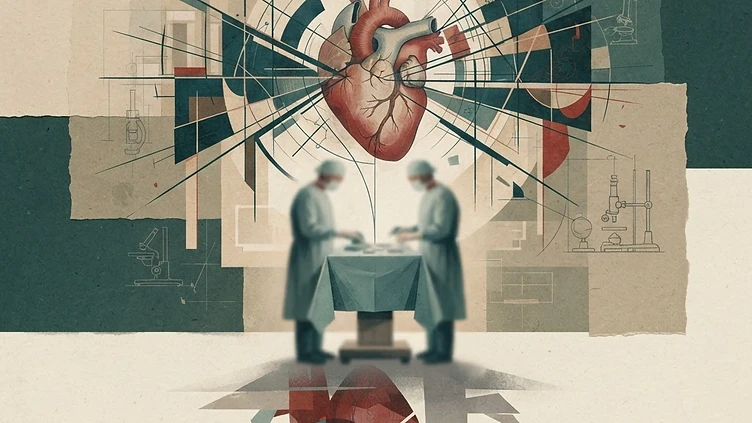
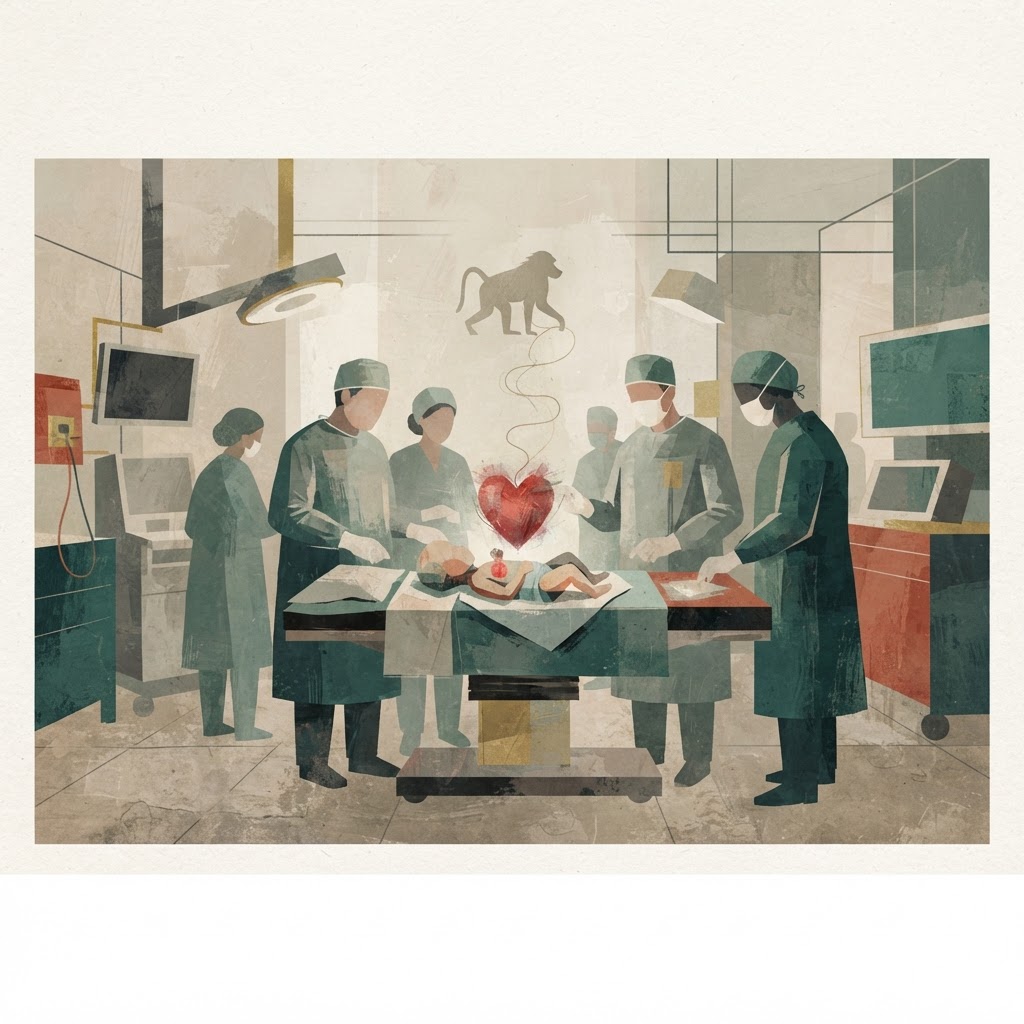
When you hold a baby, the first thing you look for is the heartbeat, isn't it? That small, persistent rhythm is the rawest proof of life. In 1984, a baby girl born in a California hospital, later known as Baby Fae, had a heart too flawed to carry that persistence from the moment she was born. To save her, doctors embarked on a path rarely seen in human history: they transplanted a baboon heart into that tiny body. This decision once again laid bare the fine line between the courage of medical science and moral boundaries, leaving behind a question that is still debated today: how far can science go to save a life? ## A Fatal Diagnosis, A Desperate Decision The baby was born with hypoplastic left heart syndrome, a condition where the left side of the heart fails to develop, which remains extremely difficult to treat even today. At the time, this diagnosis was practically a death warrant, as there was no chance of finding a suitable human donor, nor were there reliable surgical techniques for newborns. The options presented to the family were to take the baby home and await her loss or to consent to an experimental procedure. Imagine being told your child will be lost and the only alternative offered is an animal organ. This is not a cold scientific proposal; it is a doorway opened by desperation. Dr. Leonard Bailey and his team chose the baboon heart, anticipating that waiting for a human heart would not give the baby enough time. This choice was not random; it was backed by years of animal experiments, research into suppressing the immune system, and literature on cross-species transplantation. Still, it is difficult to speak of scientific necessity here, for there was no definitive proof, only a possibility. When Bailey's team decided to test this possibility in a baby's chest, they were effectively confronting the oldest dilemma in medicine: every step taken into the unknown is both a hope and a gamble. The baby's family agreed to this gamble because they had been offered no other choice. ## The Scientific World Divided When news of the operation broke, the expected applause in medical circles was replaced by shock and skepticism. One segment viewed it as a courageous breakthrough, a step showing that transplant surgery could push its limits and that humanity would not remain helpless in the face of organ shortages. Others asked the question in reverse: was turning a baby's body into a testing ground for an unproven method a matter of scientific curiosity or an ethical violation? This group emphasized the sensitivity regarding the patient's age; an adult could consent to the risk, but making that decision on behalf of an infant carried a different moral weight. A portion of the debate also came from animal rights circles. To what extent did sacrificing a baboon's heart to extend human life justify the hierarchy between species? This question has not found a complete answer even today, as the issue was not limited to scientific success but challenged the boundaries of a human-centric morality. Some defended Bailey's move as a sacrifice to save a human life, while others argued that it viewed the animal merely as a storehouse for spare parts. Perhaps most striking is that none of the parties in this debate were entirely wrong. Science, while progressing, sometimes has to question its own conscience, and the Baby Fae case brought this questioning into the public eye. ## The Legacy of Twenty-One Days The baby lived for twenty-one days after the surgery. By modern medical standards, this period was short, but for that time, it could be considered the longest resistance a body fighting immune rejection could offer. The baby's death resonated deeply in the press because the public read this case not just as a medical failure, but as a moment that forced a reconsideration of humanity's relationship with animals. Some critics argued that the family was not sufficiently informed before being included in the experimental process, while others claimed the team did not put enough effort into searching for a human donor. Each of these criticisms was, in fact, asking the same question from different angles: where does scientific courage end and ethical responsibility begin? Baby Fae's death led the field of transplant medicine to approach human-animal organ trials with more caution. Although this field, which we now call xenotransplantation, has returned to the agenda with the development of genetic engineering, it has transformed into a process that is much more controlled and subject to significantly more ethical oversight than those early experimental leaps. At the root of this transformation lies the mark left by a baby's brief life. Medical history sometimes advances not through success stories, but through questions asked in the aftermath of a loss, and the Baby Fae case is one of the sharpest examples of this. Even if twenty-one days is negligible compared to a human lifespan, the legacy it left to medical ethics debates remains vivid. Looking back today, it is incomplete to read Baby Fae's story only as a surgical intervention. This story is a mirror that questions how far science is willing to go and what costs it is prepared to pay while trying to save humans. The baboon heart beating in that small body was, in fact, a moment when humanity faced its own limits; it was neither a total victory nor a total defeat, but an experiment suspended between the two. Perhaps the true legacy is that it left no definitive answer, forcing us to continue asking the same question: when does using another living creature's body as a tool to save a life constitute courage, and when is it a violation?
İlgili Denemeler
Can the Human Brain Detect Magnetic Fields?
Geophysicist Joseph Kirschvink's experiment at Caltech indicates that the human brain responds to magnetic fields, raising questions about a potential sixth sense.
Jan Hendrik Schön: The Physicist Who Fooled Science
The scandal of Jan Hendrik Schön's fabricated data at Bell Labs highlights the critical vulnerabilities in the scientific peer-review system.
Barry Marshall Drank Bacteria to Prove Stomach Ulcer Theory
Barry Marshall made medical history by consuming harmful bacteria to prove that stomach ulcers are caused by an infection rather than stress alone.
Tartışma (0)
Henüz yorum yok. İlk yorumu siz yapın.
Join the Newsletter
New essays, once a week, delivered to your inbox.