Axolotl: What Can Medical Science Learn from Regeneration?
As a salamander rebuilds its lost leg, heart, and even parts of its brain, it forces scientists to ask why mammals cannot do the same.
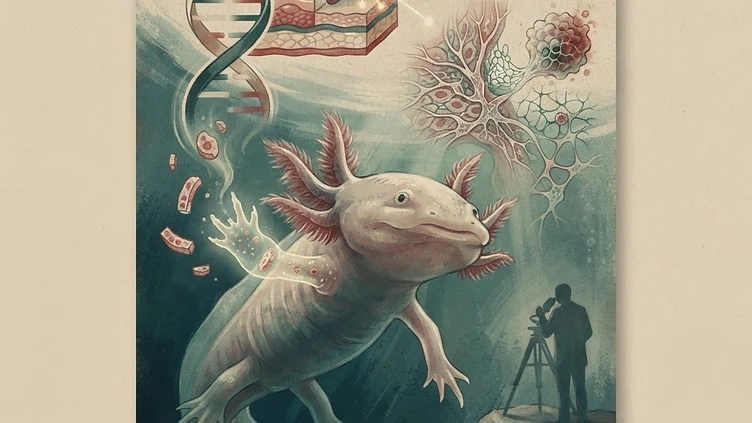
Watching a salamander swim slowly in water, we realize we are touching one of the most fundamental human fears: loss. The fear of not being able to get back an arm, an organ, or perhaps a part of ourselves. The strange, pinkish creature called the axolotl seems to carry the answer to this very fear within its body. If you cut off its leg, within a few weeks it grows a new one with the same bone structure, muscle fibers, and skin. If you remove a piece of its heart, it repairs itself. If its brain is damaged, the neurons are rewoven. Such a simple biological fact holds one of medicine’s greatest questions directly in front of us: why can we not do this?
The Mystery of the Severed Leg
What happens when an axolotl loses a leg may look like a miracle at first glance, but it is actually a highly orderly cellular choreography. Cells accumulate at the cut surface, forming a cluster called a blastema, which functions like a construction site. Each cell knows where to go and which tissue to turn into; bone cells go to bone, muscle cells to muscle, and skin cells to skin. For the scientists observing this process, the real question is how these cells possess such precise memory and how they remember which part of the body they are in. Because the regrown limb is not a random mass of tissue, but an exact copy of what was lost.
What is interesting here is that this ability is not a miracle unique to the axolotl. In fact, most of our vertebrate ancestors had a similar repair program early in evolution. Even a human embryo has the potential to regrow a fingertip if it were lost in the womb; however, this capacity is locked away after birth. So, the issue is not discovering a new ability, but tracking down a lost one. The axolotl keeps an active genetic program that evolution forgot or perhaps consciously abandoned. This shifts the focus of the question: the real issue is not why the axolotl can do this, but why we lost it.
This loss has a significant cost. Mammals heal by leaving scars, closing damage with collagen filling, but they can never regenerate the same tissue. This is why a human heart that has suffered a heart attack is left with scar tissue, and that tissue can never contract again. In the axolotl, no scar tissue forms after heart damage; cells divide and differentiate into functional heart muscle. This difference is more than just a curiosity; it is a dream scenario for cardiology. But for that dream to become reality, we must first understand where and how this genetic lock was closed.
A Body Untouched by Cancer
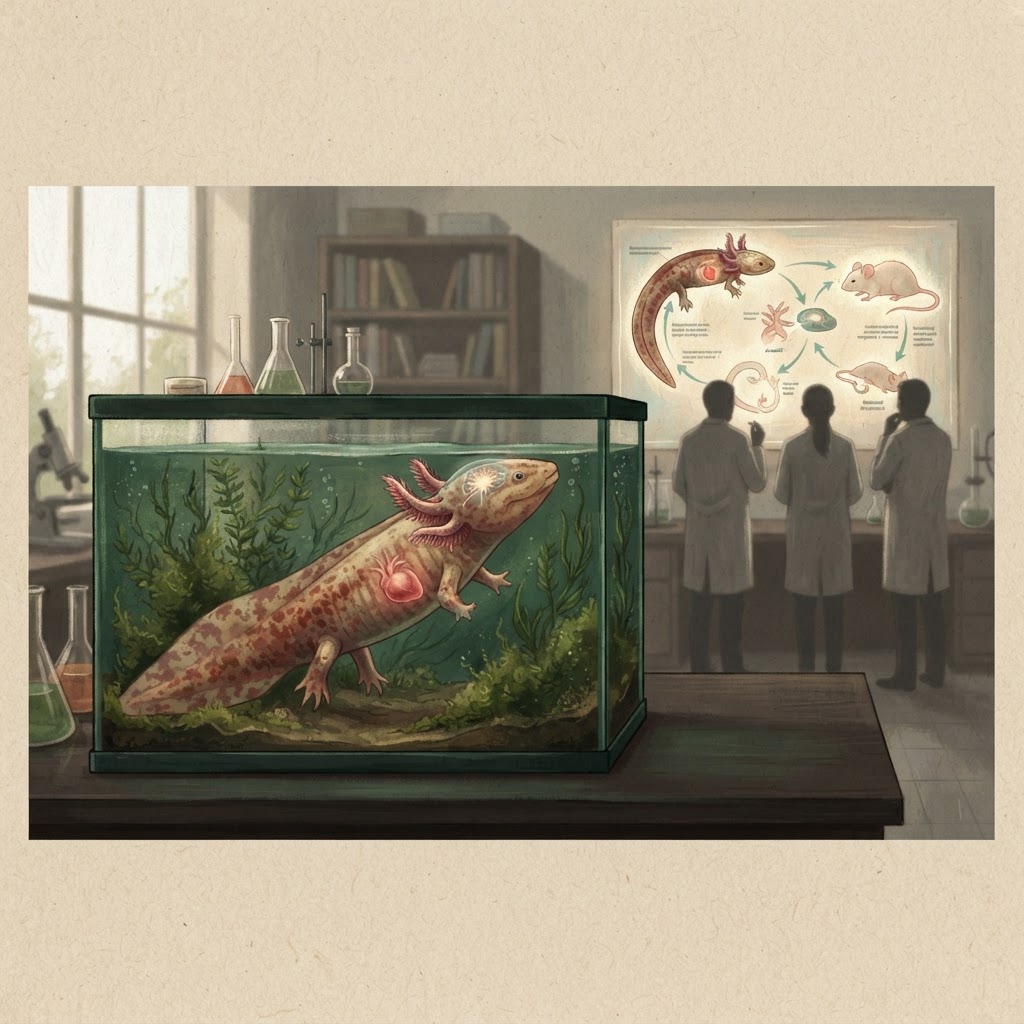
Another feature of the axolotl, as surprising as its regenerative capacity, is that it remains cancer-free despite such intense cell division. Consider that when a wound heals, cells multiply rapidly, but this proliferation never spirals out of control. In the human body, rapid cell division, especially in post-injury recovery, can create a foundation that increases the risk of cancer. In the axolotl, this risk is virtually non-existent. This leads scientists to question how the cell cycle is so strictly regulated.
Here, we encounter an interesting paradox: rapid growth is usually associated with a lack of control, yet in the axolotl, rapid growth appears in its most disciplined form. As cells multiply, they seem to know their limits, carrying within them the knowledge of when to stop and when to differentiate. This observation opens a new window for cancer researchers; because the axolotl’s natural resistance provides a reference point for understanding the working mechanisms of tumor suppressor genes in human cells. Perhaps the way to defeat cancer is not by finding a new drug, but by rediscovering this disciplined growth program.
Can It Be Transferred to Humans?
Faced with all this data, the human mind immediately wants to jump to the next step: can we transfer this mechanism to humans? Unfortunately, that is where things get complicated. The axolotl’s genome is much larger and more irregular than the human genome; a large portion of its genetic material consists of repetitive sequences, which makes reading the genes and understanding their functions difficult. A genome's size is not necessarily related to its complexity, but in the case of the axolotl, this size creates a real labyrinth for researchers.
Furthermore, mammalian cells follow a very different path during development. Once human cells differentiate, they pass through a door that is almost impossible to return through, permanently locking their cell identity. In the axolotl, this door remains ajar; cells can change their identity when needed, reverting to a primitive state. Overcoming this difference is not just about turning a genetic key; it requires reorganizing an entire developmental architecture. Nevertheless, these difficulties do not render the research meaningless; on the contrary, even without a directly applicable human solution, studying the axolotl rewrites the fundamental rules of cell biology for us.
Perhaps that is the true value: the axolotl may not provide a miracle cure, but understanding the mechanisms at work in its body allows us to better see why human cells behave so restrictively. Science does not always provide direct solutions; sometimes, it simply helps us ask the question more accurately. The axolotl may never give us the formula for regrowing limbs, but it will help us understand why loss is permanent.
This entire story tells us much more than just the oddity of an animal. The axolotl stands as a reminder of a possibility that evolution left behind in a corner; it forces us to question why the human body is so limited and fragile. Perhaps the real issue is not wishing to be like it, but accepting the possibility it shows us: regeneration is not biologically impossible, just a forgotten language. And as science tries to relearn this forgotten language, standing by the aquarium where a salamander swims silently, it looks again at one of humanity's oldest questions.
İlgili Denemeler
Can the Human Brain Detect Magnetic Fields?
Geophysicist Joseph Kirschvink's experiment at Caltech indicates that the human brain responds to magnetic fields, raising questions about a potential sixth sense.
Jan Hendrik Schön: The Physicist Who Fooled Science
The scandal of Jan Hendrik Schön's fabricated data at Bell Labs highlights the critical vulnerabilities in the scientific peer-review system.
Barry Marshall Drank Bacteria to Prove Stomach Ulcer Theory
Barry Marshall made medical history by consuming harmful bacteria to prove that stomach ulcers are caused by an infection rather than stress alone.
Tartışma (0)
Henüz yorum yok. İlk yorumu siz yapın.
Join the Newsletter
New essays, once a week, delivered to your inbox.