The Blue-Blooded Hero: Horseshoe Crab and Medicine
Having remained virtually unchanged for 500 million years, this crab still single-handedly guarantees the safety of modern medicine.
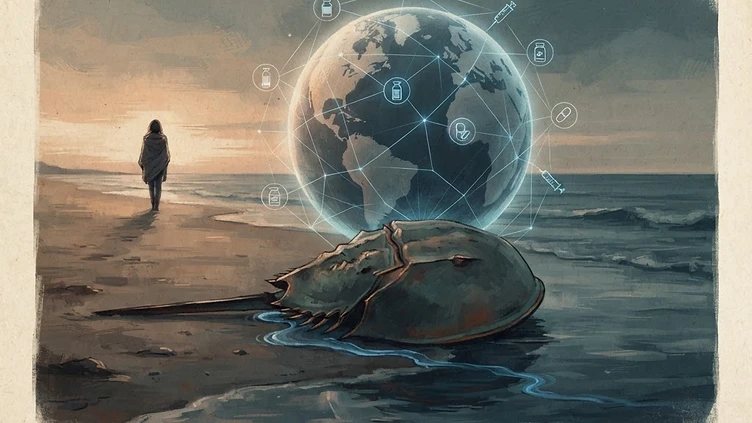
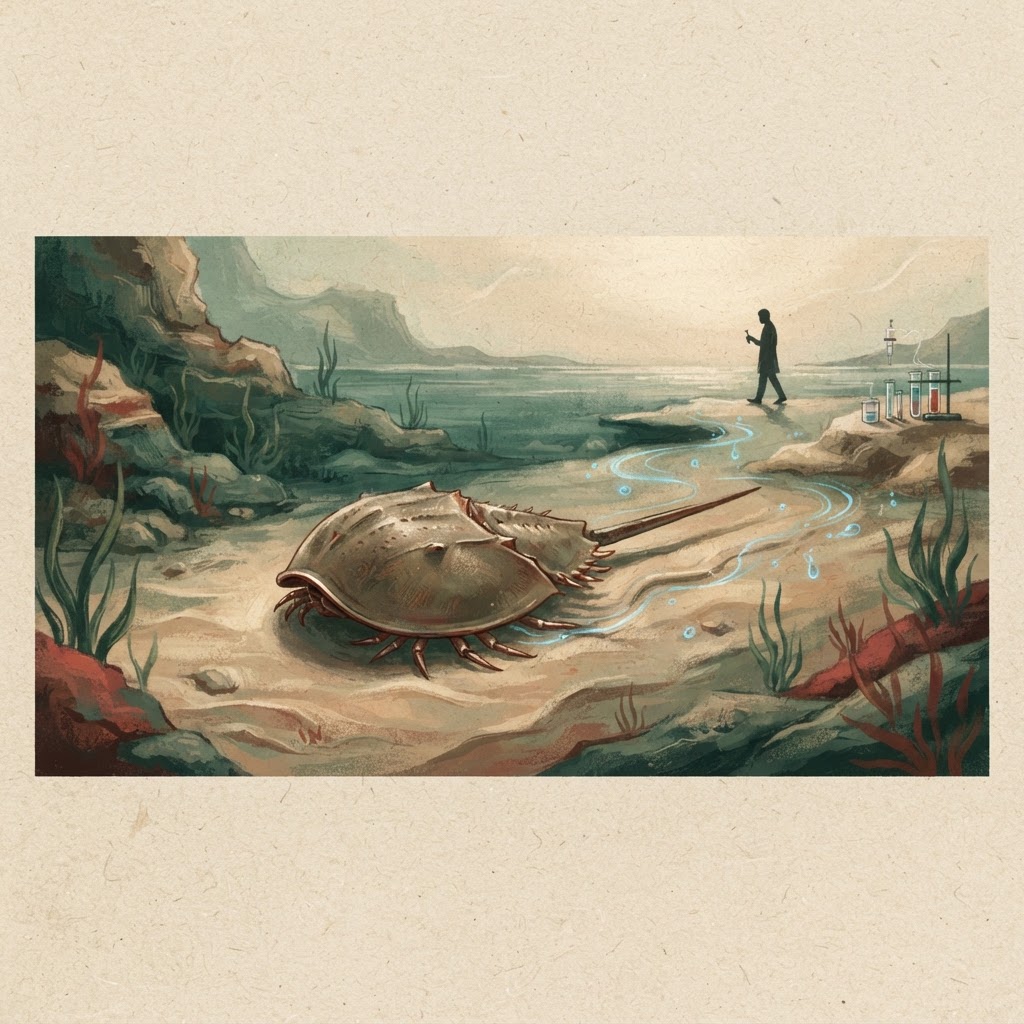
Imagine a blue liquid standing still inside a sterile vial in a laboratory. At first glance, you might mistake it for a chemical dye or perhaps an experimental pigment. Yet, that blueness has been filtered through the veins of a creature that has been crawling on the ocean floor for hundreds of millions of years. This strange, armored creature we call the horseshoe crab stands silently behind us in our most fragile moments—those moments when a needle tip enters our skin. Every vaccine, every serum, every drug vial is considered safe because of this crab. Is it fair for a species to bear such a vital, one-sided responsibility? This question is the true axis of this essay. ## 500 Million-Year-Old Master of Survival The story of the horseshoe crab is a story where time cannot be told through scales we are accustomed to. This creature began crawling on the shallow shores of the ocean at a time when dinosaurs had not yet appeared and the continents were joined in a configuration very different from today's map. Over the five hundred million years that have passed, continents shifted, ice ages came and went, and countless species were wiped from the face of the earth; yet this crab, with its armored shell and horseshoe-like silhouette, has remained almost entirely unchanged. It is as if evolution did not abandon it but rather perfected it at a very early stage and set it aside. The fact that a species remains in the same form for so long gives one a strange sense of unease. We are a species that changes our phones, our homes, and even our perception of our own bodies in every generation, while this crab walks with the same patience in the seas of distant geological ages as it does on today's polluted shores. Perhaps the secret to survival is not constant change, but finding the right balance point early and holding onto it. Yet this constancy is not a guarantee; for although nature does not change it, the variability of the human hand is now at play. ## The Secret of Blue Blood: Limulus Amebocyte Lysate The reason this crab's blood is blue is that it carries hemocyanin containing copper instead of the iron-based hemoglobin in human blood. But what makes it indispensable to medicine is not its color, but the way its immune system works. While the human body responds to a bacterial threat with a complex cellular army, the amebocyte cells in this crab's blood provide a much more primitive, direct response: as soon as they detect even the slightest bacterial endotoxin, they coagulate and trap that area. This simple yet brutally sensitive reaction forms the basis of the test known in laboratories as Limulus Amebocyte Lysate. Now imagine this: there are thousands of vaccine vials coming off a production line in a pharmaceutical factory, and it must be absolutely certain that none of them carry invisible bacterial contamination before being injected into a human. Here, a few drops of blood taken from that crab are added to a test tube, and if there is the slightest endotoxin in the vial, the liquid visibly coagulates. Such a simple, direct warning system has not been imitated with equal reliability by any man-made device—at least, not for a long time. Consequently, the global pharmaceutical industry has, in a sense, entrusted its safety to the immune response of this sea creature, and this dependence resembles a more fragile alliance than it appears. ## The Sustainability Crisis: Nature or Industry? But this alliance has a cost. Every year, hundreds of thousands of horseshoe crabs are collected from the shore and transported to laboratories, where some of their blood is drawn before they are returned to the sea. The industry presents this as a gentle exchange, claiming the crab does not die but merely makes a donation. However, the reality is more complex: after the blood-drawing process, some crabs become weak, some experience stress during their breeding periods, and some never return at all. While the loss of these individual crabs may seem small for coastal ecosystems, when viewed through the lens of migratory bird populations dependent on the species' eggs, the effect becomes a chain reaction. One might object: if this method has worked for so long and protects human health, why change it? But the question is posed incorrectly; the issue is not whether the method works, but whether it is sustainable at the cost of a species. In recent years, synthetic, recombinant-based tests have shown they can provide the same sensitivity without the need for crab blood, yet the industry slows this transition under the weight of habit and established standards. Perhaps the real question is: is a species doomed to turn its back on the sea and give us its blood forever for our own safety? Or is resolving this dependency a necessity for both science and conscience? The horseshoe crab managed to survive for five hundred million years without owing anyone anything; yet in the last century, against its own will, it has become the secret guardian of humanity's most fragile moments. This strange partnership shows, on one hand, the generosity of nature and, on the other, the laziness of humans in giving up their habits. Perhaps the real issue is not to heroize or blame this crab, but to acknowledge what we owe it and consider how to pay that debt. For if one day we go out to the shores looking for this armored silhouette and realize it is no longer there, it will not just be a species we have lost; we will have lost the silent guarantee of our own safety.
İlgili Denemeler
Can the Human Brain Detect Magnetic Fields?
Geophysicist Joseph Kirschvink's experiment at Caltech indicates that the human brain responds to magnetic fields, raising questions about a potential sixth sense.
Jan Hendrik Schön: The Physicist Who Fooled Science
The scandal of Jan Hendrik Schön's fabricated data at Bell Labs highlights the critical vulnerabilities in the scientific peer-review system.
Barry Marshall Drank Bacteria to Prove Stomach Ulcer Theory
Barry Marshall made medical history by consuming harmful bacteria to prove that stomach ulcers are caused by an infection rather than stress alone.
Tartışma (0)
Henüz yorum yok. İlk yorumu siz yapın.
Join the Newsletter
New essays, once a week, delivered to your inbox.