Antikythera Mechanism: The Lost Tech Mystery
Why was the complex gear technology produced by Ancient Greece forgotten for centuries only to be rediscovered during the Renaissance?
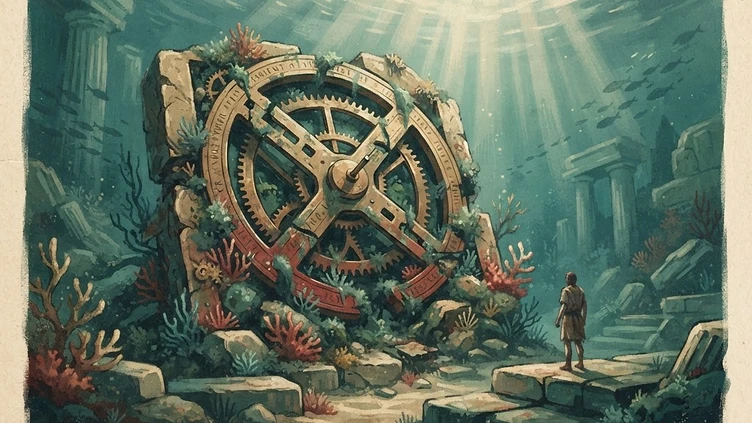
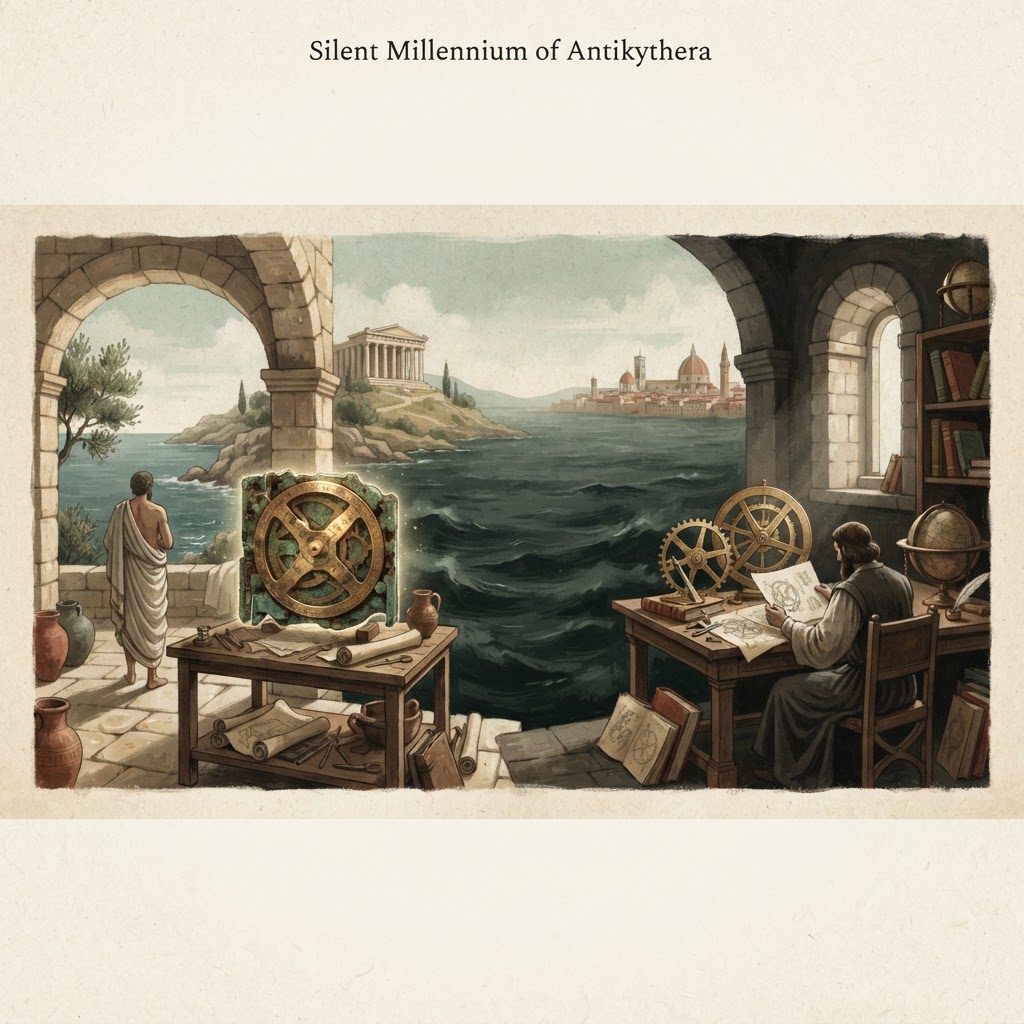
In 1901, something caught in the nets of sponge divers in the dark waters of the Aegean Sea: a lump of green, rusted metal that seemed worthless at first glance. Years later, a mechanism emerged from this mass that exceeded the imagination of the ancient world; a small model of the universe consisting of over thirty gears, calculating the phases of the Moon, solar eclipses, and the movements of the planets. This instrument, which we call the Antikythera mechanism, continues to baffle historians of technology even today. The question that arises is not technical, but temporal: How could such advanced knowledge be buried in silence for centuries, only to suddenly bloom again in the hands of Renaissance clockmakers? In this essay, I want to look into that thousand-year silence; I am interested in the way it was lost as much as in what was lost itself.## The Universe Inside the GearsWhen we look at the Antikythera mechanism, what we see is not actually a clock, but a mathematical translation of the sky. Ancient Greek astronomers had already transformed the celestial movements they observed into numbers, ratios, and geometric relationships; yet this mechanism brings that abstract knowledge into a tangible object. As you turn a crank, the phases of the Moon change, solar eclipses are predicted, and perhaps the years of the great games are calculated. This translation of the abstract into the concrete with such fidelity shows us how early the human mind reached the idea of modeling. What is surprising here is not just the knowledge itself, but the courage to entrust that knowledge to a physical object.Where does this courage come from? I think observing the sky itself forces a person into a translation process: reducing the rotation of the stars to numbers, and those numbers to gear ratios, is a way of making the world intelligible. The Antikythera mechanism stands before me like an intersection of Pythagorean number mysticism and Archimedes' mechanical genius; one tries to explain the universe through numbers while the other turns those numbers into a working machine. Thinking about the computing power carried on the wrist of someone wearing a smartwatch today, I realize that the two-thousand-year distance is shorter than we think. Perhaps it comforts us to imagine the history of technology as a straight line, but Antikythera breaks that line from the very beginning.## The Physics of Lost KnowledgeThe existence of such a device seems like a miracle, but the real question is the silence that followed. We encounter a mechanism of similar complexity in Europe only towards the end of the Middle Ages, with the rise of clock towers. The gap in between seriously shakes the idea that science is a river that accumulates and always flows forward. Yet what we see here is the reality that knowledge is something fragile, stored in a vessel, in specific hands, in specific workshops. The breaking of that vessel means the contents are spilled and lost; as if knowledge were not a light that spreads on its own, but a flame dependent on its bearer, extinguishing when the bearer vanishes.An objection immediately rises within me: perhaps the knowledge was not completely lost, but simply did not reach written sources, continuing quietly within a tradition passed down orally or by hand. This may be so; but even this possibility does not change the core issue, because knowledge that has not been recorded is effectively considered lost as soon as one generation is skipped. Thinking about how many times great libraries, workshops, and craft guilds have been dispersed throughout history by wars, fires, and political dissolutions, I see that it is not progress, but continuity, that is truly fragile. Science here stands before me not as an accumulation, but as a legacy that every generation must re-earn; and if the legacy is not handed down, even the most brilliant invention is destined to rust under the soil.## The Craftsman's Shadowed MindWe do not know whose hands produced the Antikythera mechanism. Was it one of the followers of Archimedes, an anonymous master from a workshop in Rhodes, or someone else entirely whose name history never recorded? This uncertainty disturbs me, because history usually gives us the names of philosophers, not the hands that made the tools. We can recite Plato and Aristotle by heart, but the person who designed this mechanism, cut the gears, and calculated the ratios has remained nameless. It is as if thought becomes immortal the moment it is committed to writing, but when the same thought is carved into metal, its name is destined to be erased.This reminds me that the history of science is actually a history of selectivity. What is recorded, preserved, and praised has always been the word; the knowledge of the hand, the tool, and the craft has mostly remained in the shadow of the word. Yet the person who made the Antikythera mechanism must have had as deep an understanding of mathematics as any astronomer; they had to account for trigonometry, periodic movements, and margins of error to get the gear ratios right. Perhaps most of the great inventions come from the hands of someone working patiently in their workshop who never entered the light of history; what we call genius today is often nothing more than a label stuck onto this anonymity after the fact.The thousand-year silence of the Antikythera mechanism shows me that progress is by no means guaranteed. The most advanced knowledge reached by a society can vanish along with the people who carry it; then the same knowledge can be reborn in a completely different geography, with completely different names, as if it had never been lost. Looking at the technology in our hands today and thinking that this can never be taken back is perhaps the greatest illusion history has given us. That rusted mechanism emerging from the bottom of the Aegean does not actually show us who we are, but how prone we are to forgetting; and perhaps that is why the thing we must protect most is not the knowledge itself, but that thin, easily broken bond that carries it from one generation to the next.
İlgili Denemeler
Can the Human Brain Detect Magnetic Fields?
Geophysicist Joseph Kirschvink's experiment at Caltech indicates that the human brain responds to magnetic fields, raising questions about a potential sixth sense.
Jan Hendrik Schön: The Physicist Who Fooled Science
The scandal of Jan Hendrik Schön's fabricated data at Bell Labs highlights the critical vulnerabilities in the scientific peer-review system.
Barry Marshall Drank Bacteria to Prove Stomach Ulcer Theory
Barry Marshall made medical history by consuming harmful bacteria to prove that stomach ulcers are caused by an infection rather than stress alone.
Tartışma (0)
Henüz yorum yok. İlk yorumu siz yapın.
Join the Newsletter
New essays, once a week, delivered to your inbox.