Antikythera Mechanism: The First Ancient Computer
The rusty bronze fragments salvaged from the wreck of an ancient ship are forcing a rewrite of human technological history.
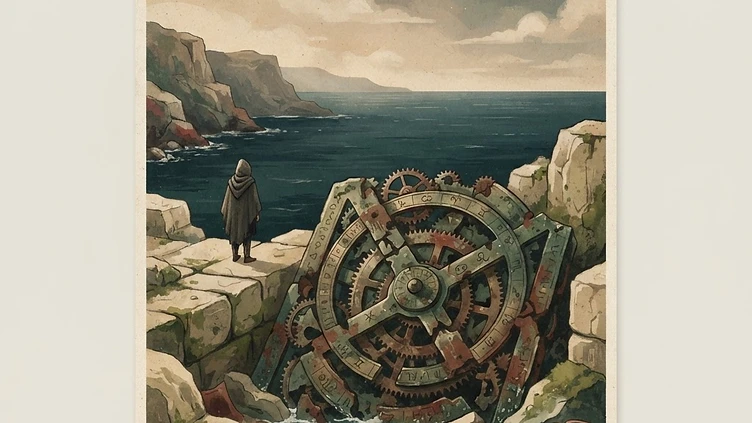
At the bottom of the Mediterranean, an object lay unnoticed for over a century, waiting to shatter our assumptions about the nature of time. Recovered from a shipwreck, this rust-covered piece, which appeared at first glance to be little more than a pile of scrap metal, has forced us to reconsider everything we thought we knew about the history of human technology. What emerged was a mechanism equipped with gears that calculated the movements of the heavens, effectively an ancestor to the modern computer. How could humanity forget such a complex invention, lose it, and why did it take over a millennium to rediscover it? These questions challenge our comfortable belief that progress follows a linear path.## A Rusty Puzzle Found by a DiverIn 1901, off the coast of Greece near the island of Antikythera, divers stumbled upon the remains of a shipwreck. The ship contained statues, ceramics, and various antique goods; these treasures immediately captured the interest of archaeologists as they represented a wealth of art history. Yet among these treasures were small, bronze fragments left in a corner, ignored by everyone. Scientists of that era assumed they were merely fragments of an old clock dial or a decorative object, as the possibility that Ancient Greece could have produced such a precise mechanical device was beyond their comprehension.The striking reality here is that these pieces did not physically vanish. They sat on museum shelves and in boxes awaiting study. What was lost was the mindset capable of reading them correctly. Scientists had trapped the ancient era within a certain technological ceiling; they were not prepared to see any evidence that surpassed it. This reveals an intriguing truth: sometimes, understanding the value of a discovery requires not excavation tools, but the courage to set aside our prejudices. The fact that the Antikythera Mechanism remained in the shadows for decades is proof of how easily we can overlook truths that stand right before our eyes.## When X-Rays Made the Gears SpeakYears later, the story changed entirely when modern imaging techniques were introduced. When scientists scanned these bronze pieces with X-rays, they discovered more than thirty interlocking gear wheels inside. These gears were not random; they were part of a system capable of predicting solar and lunar eclipses, calculating planetary movements, and tracking calendar cycles. Imagine a device that mimicked the rhythm of the sky through a mechanical gear arrangement alone, without electricity or computer chips.This discovery fundamentally altered our perception of ancient engineering. Such precision could only be achieved not just through theoretical knowledge, but through advanced metalworking. The perfect fit of the gears and the mathematical accuracy of the calculations suggest that this was not a bizarre experiment by a lone genius, but the product of a body of knowledge and a tradition of craftsmanship passed down through generations. We must ask ourselves: if this level of technology was possible in the 2nd century BC, how many other devices of similar complexity were created that did not survive to reach us? The fact that the Antikythera Mechanism is a solitary example may simply be because the sea preserved it; perhaps others rotted, melted down, or were never found.## Why Can Technology Regress?The most striking question here is: if Ancient Greece possessed this level of mechanical knowledge, why did Europe have to wait centuries to achieve similar complexity? It took a long time for the clockmaking of Medieval Europe to reach the sophistication of the Antikythera Mechanism. This directly contradicts the idea that progress follows an uninterrupted, stable line. We tend to think of history as a ladder where every step is higher and every generation is more knowledgeable than the last. Antikythera shows us that this ladder may actually be full of broken rungs.How can such knowledge be lost? The answer lies in the fact that knowledge is less about being a physical object and more about a chain of transmission. If a technique a craftsman learns from his master is not passed on to an apprentice, it disappears along with that technique. Wars, the burning of libraries, economic collapses, or simply the death of a master can break the chain of knowledge. Thus, some historians who study the Antikythera Mechanism believe that such devices in the ancient world may have been produced only by a specific elite class or a small group of craftsmen. If knowledge remains within a narrow circle, the dispersal of that circle can mean the loss of that knowledge. This shows that progress depends not only on innovation but also on the capacity to disseminate and protect that innovation.There is an objection at this point: perhaps the Antikythera Mechanism was an exceptional case rather than an indicator of the era's general technological level; perhaps it never became widespread because its production was already rare and arduous. This possibility cannot be ignored. Yet, even this reinforces the idea that progress is not linear; for even an exceptional discovery can be forgotten, showing that the preservation of knowledge is never guaranteed. Perhaps the issue is that we should think of progress as a wave: rising and falling, accumulating and dispersing.The story of the Antikythera Mechanism is not really about technology, but about the fragility of human memory. The heights reached by a civilization, if not properly protected and passed on, can remain nothing more than bronze fragments rusting at the bottom of the sea. Today, we may be in a similar state of fragility without realizing it; we have no certainty that our digital data, software, or even our computers will be intelligible a thousand years from now. Thus, Antikythera reminds us not only of the genius of Ancient Greece but also of how uncertain our own future may be.

İlgili Denemeler
Can the Human Brain Detect Magnetic Fields?
Geophysicist Joseph Kirschvink's experiment at Caltech indicates that the human brain responds to magnetic fields, raising questions about a potential sixth sense.
Jan Hendrik Schön: The Physicist Who Fooled Science
The scandal of Jan Hendrik Schön's fabricated data at Bell Labs highlights the critical vulnerabilities in the scientific peer-review system.
Barry Marshall Drank Bacteria to Prove Stomach Ulcer Theory
Barry Marshall made medical history by consuming harmful bacteria to prove that stomach ulcers are caused by an infection rather than stress alone.
Tartışma (0)
Henüz yorum yok. İlk yorumu siz yapın.
Join the Newsletter
New essays, once a week, delivered to your inbox.