Evidence of the Big Bang: The Cosmic Hum Story
Two engineers mistook the sound left over from the birth of the universe for a malfunction and tried to fix it.
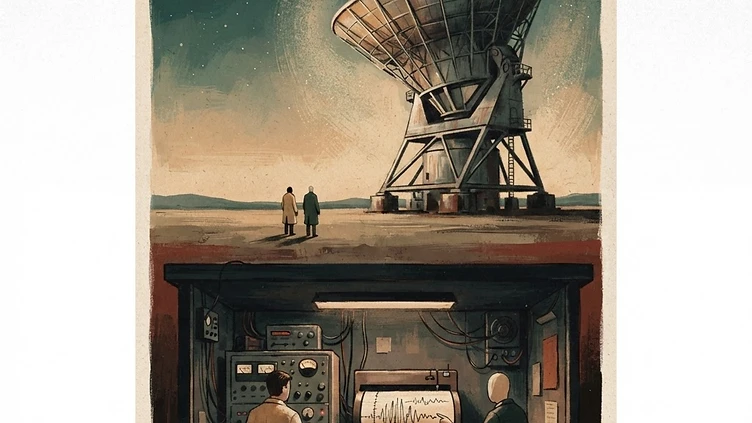
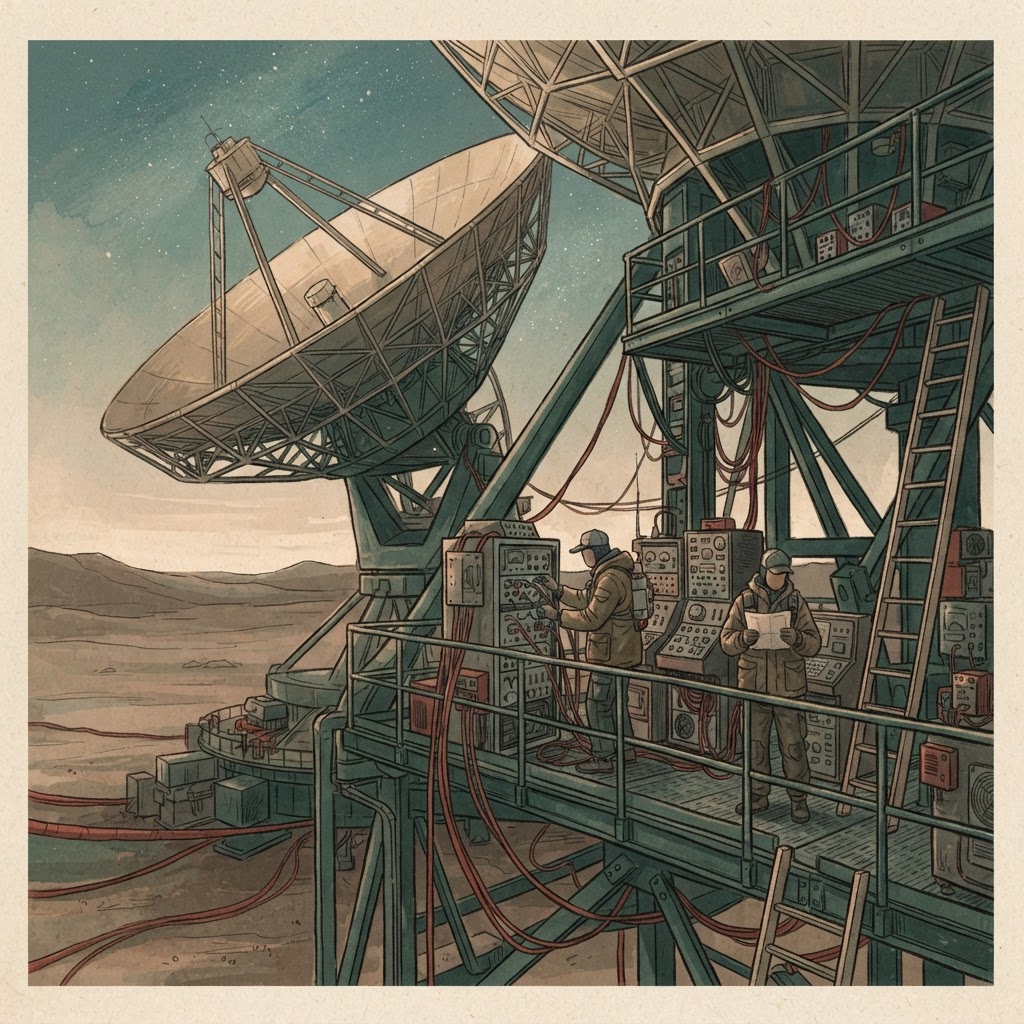
Some inventions are the product not of curiosity, but of irritation. Much like a fly buzzing around your head, there is something present that you try to fix but cannot silence; at first, you see it as a malfunction, a flaw, a mistake. In 1964, in New Jersey, an antenna perched on the roof of Bell Laboratories became the source of just such an annoyance. What the two engineers were chasing was not a glitch; it was the universe itself. But for them to understand this, they had to be wrong many times over. ## A Malfunctioning Antenna The antenna was built not to study the sky, but to handle satellite communications. This horn-shaped device was meant to capture and amplify weak signals from space, adding another link to the telecommunications company's network. But when they began testing the device, the engineers encountered a constant, persistent hiss that did not disappear regardless of which direction the antenna was turned. This was not the expected type of noise; it had no direction, no rhythm, and although it should have had a specific source, it seemed to come from everywhere. The first reaction was, in fact, a justified suspicion. When an inexplicable sound arises while a device is expected to work perfectly, the fault is sought within the device first; because the possibility of the universe being broken is always lower than the possibility of a soldering error. The engineers disconnected and reconnected cables, checked every connection point one by one, and scrutinized every inch of the electronic circuits. After each attempt where they failed to find the error, they embarked on a new one, because the possibility before them was still the most ordinary one: somewhere, something was broken. If the problem was not where they were looking, one would have to question the search itself, but they had not yet reached that stage. ## The Guilt of the Pigeons When they scoured the inside of the antenna, what they found was not a scientific flaw, but a rather mundane mess: pigeons had chosen this wide, horn-shaped structure to build their nests. Believing they had finally found the source of the noise, the engineers chased the birds away, cleaned the mess they had left, and even polished the inner surface of the antenna. This was the most reasonable explanation because it is humanity's oldest reflex to attribute every anomaly in nature to a living agent; blaming a bird for a problem is far easier than attributing it to the nature of the universe. But the noise did not go away. The antenna was spotless, the connections were solid, and the birds were long gone; yet, that same hiss remained with the same patience and indifference. This is where the true breakthrough occurred. Because when an explanation is exhausted, a person chooses one of two paths: either they link the same question to another flaw and keep searching, or they realize the question itself might have been posed incorrectly. The moment the engineers realized the birds were not to blame, they had, perhaps unknowingly, turned their questions from the world toward the sky. The source of the noise was no longer to be sought in the device or its surroundings, but in a place too vast to measure. ## The First Whisper of the Universe Around that time, another group of scientists was making a strange prediction through theoretical calculations: if the universe had truly begun with an explosion, a cooled radiation, spread equally in every direction, must remain from the heat of that first moment. This radiation could be perceived not as visible light, but as a faint and pervasive signal in the microwave range. That stubborn hiss the engineers captured on their antenna fit this definition perfectly: directionless, timeless, coming from every point with the same intensity. This was not a malfunction; it was a trace of the universe's birth fourteen billion years ago, still echoing in the depths of space. This meant more than just the solution to a technical puzzle. The Big Bang theory.heory.heory had, until then, consisted of mathematical elegance and indirect observations; there was evidence showing the universe was expanding, but a direct trace of its birth had not yet been obtained. This noise was the concrete, tangible evidence the theory sought. Our intuition that the vacuum of space was silent and cold was actually wrong; as we look in every direction, a whisper from the first moment of the universe accompanies us. In the place where we expected silence, we found the oldest sound. Perhaps the most striking aspect of this story is not what was found, but the initial reaction to it. Two engineers treated a trace left over from the birth of the universe first as a flaw, then as pigeon droppings; because the greatest truths sometimes arrive in the guise of the most mundane annoyances. Perhaps we do not know how many sounds there are around us today that we still try to fix, mistaking them for malfunctions because we cannot explain them. That noise the antenna could not silence actually teaches us this: sometimes the thing we are trying to silence is the most important thing we need to listen to.
İlgili Denemeler
Can the Human Brain Detect Magnetic Fields?
Geophysicist Joseph Kirschvink's experiment at Caltech indicates that the human brain responds to magnetic fields, raising questions about a potential sixth sense.
Jan Hendrik Schön: The Physicist Who Fooled Science
The scandal of Jan Hendrik Schön's fabricated data at Bell Labs highlights the critical vulnerabilities in the scientific peer-review system.
Barry Marshall Drank Bacteria to Prove Stomach Ulcer Theory
Barry Marshall made medical history by consuming harmful bacteria to prove that stomach ulcers are caused by an infection rather than stress alone.
Tartışma (0)
Henüz yorum yok. İlk yorumu siz yapın.
Join the Newsletter
New essays, once a week, delivered to your inbox.