Ostracism: The Athenian Tradition of Exile
How did Athenian democracy exile a citizen for simply being 'too powerful' in the eyes of the people, without having committed any crime?

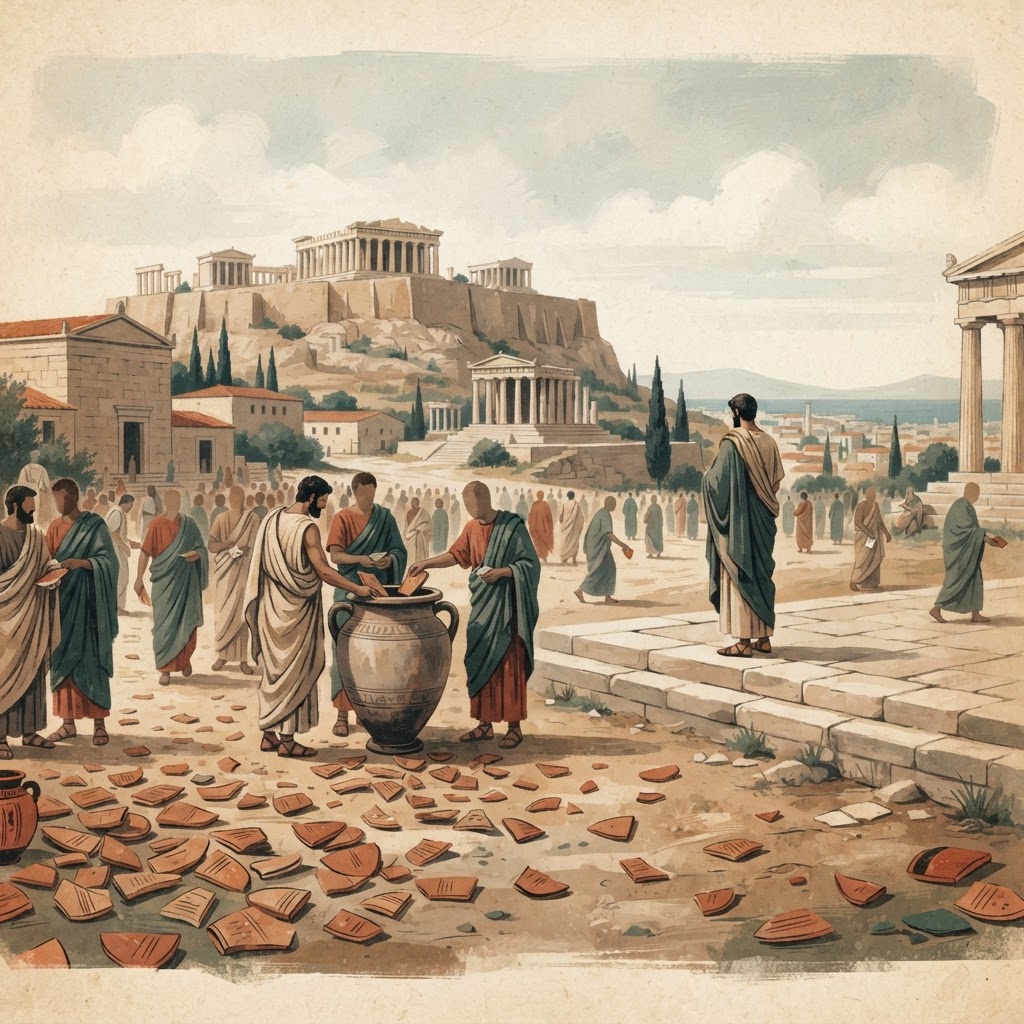
Imagine a morning in the Athenian agora. The sun has not yet risen, but the square is already crowded. Everyone holds a piece of pottery in their hand, a fragment of a broken jar or an amphora. Each citizen leans down to scratch a name onto that shard, then drops it into the large vessel in the center. No one has been summoned to court, no one has faced an indictment, and no one has hired a lawyer. Only a name has been written, and for the person who wrote it, even if they have done nothing, that name could open the doors to a ten-year exile by morning. This scene, which seems strange to us today, was the most unsettling invention of Athenian democracy: ostracism. There was no crime, yet there was a punishment. There was no evidence, yet the verdict was final. So, how can a society exile a person without showing any concrete justification, and even consider it the most magnificent triumph of democracy? ## The Rule of the Game: No Crime Required The most striking aspect of ostracism was that it inverted the concept of law. In the understanding of justice we know, first an act occurs, then that act is deemed a crime, a court investigates it, and finally, a punishment is determined. In this unique Athenian vote, the order was completely disrupted. The punishment came first, while the justification consisted merely of a vague sense of unease among the public. Citizens would gather every year to answer a simple question: is there anyone among us who threatens us with their power or influence? If enough people said yes, on a designated day everyone wrote a name on their ostrakon, and the person who received the most votes was exiled for ten years—without their property being touched and without losing their citizenship, but stripped from the city. Here, one must pause and ask: was this a punishment or a precaution? In the language of modern law, it might be called a preventive measure, but even preventive measures are usually based on a sign or a trace. In ostracism, no trace was sought; a feeling was enough. A person could be cast out without breaking a law or causing any harm, simply for being too bright, too influential, too trustworthy, or too popular in the eyes of society. This made ostracism the oldest institutionalized preventive exile mechanism we know in history because what was being punished here was not behavior, but the possibility that behavior could lead to something. The Athenians were essentially saying: we do not find you guilty now, but because we do not know what will happen in the future, we are removing you beforehand. ## A Weapon Against Tyranny, a Trap for a Rival The moment this mechanism was born, it was fueled not by pure idealism, but by concrete fear. Underneath this practice, shaped by the reforms of Cleisthenes, lay the memory of the suffering Athens had endured during periods of tyranny. They feared that one person, no matter how talented or beloved by the people, could seize all the power of the state alone and turn it into a permanent rule. Ostracism was designed as an insurance policy against this fear: no matter how powerful someone became, the people could cast them out at any moment with a vote. In theory, this was the self-protective reflex of democracy; a preventive response by society against the consolidation of power in a single hand. Yet institutions do not always remain faithful to their founding purposes. Over time, ostracism transformed from preventing tyranny into a tool for managing political competition. Figures who stood out with their strategic intelligence like Themistocles, individuals known for their integrity like Aristides, or leaders who rose in the eyes of the public with their military successes like Cimon, became targets precisely because they were powerful. Political rivals began using this vote to clear their own paths, inciting the public against a specific name without considering whether the person was truly dangerous. Thus, the weapon invented against tyranny gradually turned into a means of legitimately eliminating a rival. The irony is that this transformation required no legal changes; the mechanism remained the same, only the intention changed. This shows us that to understand whether an institution is fair, it is not enough to look only at its rules; one must also examine the intentions with which those rules are operated. ## From Potsherd to Screenshot A counter-argument rightly comes to mind here: this is an ancient practice, it has nothing to do with today's state of law, so why are we talking about it? Yet, the logic behind ostracism still lives among us as a social reflex, even if its institutional framework has collapsed. Today, there are many ways to neutralize a person through social pressure without taking them to court, presenting evidence, or granting them the right to defense; only the tool has changed, as the shard of pottery has been replaced by the screenshot and the town meeting by a scheduled post. When an allegation circulated about a person enters circulation without its truth being investigated and stripped of its context, that person can be gradually exiled from their surroundings, their job, and their reputation. There is no court, but there is an execution. The accusation is unproven, but the punishment is already applied. The most chilling aspect of this analogy is the claim that in both cases, the legitimacy comes from the people—that is, the majority. In Athens, this was measured by the count of votes; today, it is measured by the likes a post receives or the number of people a hashtag reaches. But the size of the number does not guarantee the truth of the decision. On the contrary, the rapid and emotional reaction of the majority often precedes the slow and patient investigation of the truth. The question of whether a person is truly harmful gets mixed up with the question of whether they appear too visible; just as in Athens, power itself aroused suspicion even before it was misused. The cancel culture of the digital age actually reproduces that old logic of ostracism—which required no evidence and was based solely on collective discomfort—on a much faster and wider scale. Perhaps the real question is not whether this mechanism is inherently bad, but under what conditions it can be considered legitimate. A society wants to recognize and stop a power that could become genuinely dangerous; the desire itself is not unreasonable. The problem begins with the procedure, the oversight, and the assurance of justice with which this desire is implemented. The Athenians tried to establish this balance and failed, because their mechanism was built on feelings, not evidence. Today, we face a similar temptation; we just do not have a potsherd, we have a screen. Perhaps the difference between the citizen who leaned down in the agora that morning to write a name and the person reposting a post on their phone screen today is much smaller than we think. Both ask themselves the same question: is this person really dangerous, or am I bothered only because I find them too visible? Athens answered this question wrongly two thousand five hundred years ago, and we are still walking in the footsteps of that answer.
İlgili Denemeler
The Mechanical Turk: History's Chess-Playing Mystery
The chess-playing automaton known as the Mechanical Turk deceived figures like Napoleon and Benjamin Franklin, masking a hidden human operator as a machine.
Bournville: The Utopian Town Built by Chocolate
The streets, gardens, and teetotal order of Bournville reveal how the Quaker faith imprinted a distinct form of morality upon the foundations of industry.
Levi's: The Story of Riveted Jeans Born from Gold Rush
In 1873, a tailor's discovery of a riveted solution for torn pockets redirected the true fortune of the gold rush toward the enduring garment industry.
Tartışma (0)
Henüz yorum yok. İlk yorumu siz yapın.
Join the Newsletter
New essays, once a week, delivered to your inbox.