Acoustic Kitty: The Failed CIA Spy Cat Project
The Cold War's strangest intelligence experiment revealed why transforming a living organism into an electronic instrument is nearly impossible.
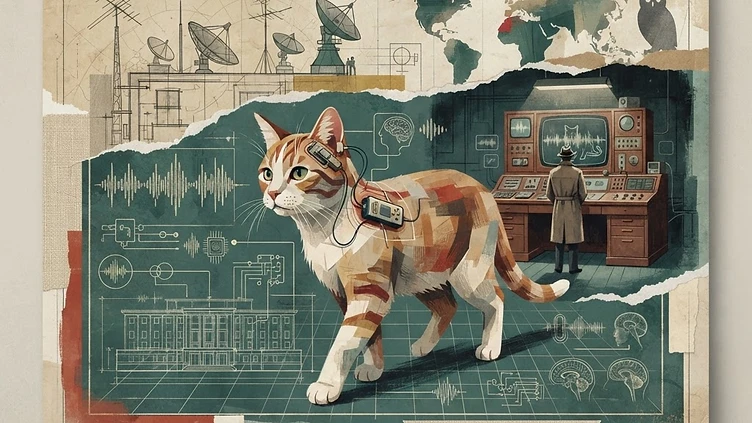
The human mind sometimes pursues a childish dream even in the hands of the most serious institutions: What if we could transform a living being into an instrument that transcends its own physical limitations? The CIA's Acoustic Kitty project, launched in the 1960s, was exactly that strange answer to this question. Converting a cat into a listening device was an endeavor that seemed clever on paper, yet in practice, it poignantly demonstrated that biology does not bow to human will. Looking back at this story today, we see not just a bizarre CIA fiasco, but also how fragile the dream of merging the living with the artificial truly is. ## Cold War Animal Spies The intelligence world of the Cold War was an era devoid of today's digital surveillance tools, yet one that operated with limitless imagination. While satellite imaging was still in its infancy, electronic listening devices were bulky and easy to spot. Placing an agent directly near a target was often impossible because the human body invited suspicion; however, an animal, especially a cat that was an ordinary part of daily life, could wander through an embassy garden or outside an ambassador's window without drawing attention. This simple observation drove certain engineers and scientists within the CIA toward the idea of turning animals into surveillance tools. This effort was not limited to cats; checking the archives of the era reveals that pigeons and even marine life were considered in similar ways. But the cat was an especially attractive option because it could move silently, was accustomed to human proximity, and no one would suspect a state institution behind a cat. What is interesting here, as much as the technology itself, is the desperation behind the decision to turn to a living body to bypass the limits of technology. While electronic miniaturization was not yet sufficiently developed, finding a biological carrier was not a solution to an engineering problem, but a way of adding another; yet for the intelligence mindset of that era, this seemed like a gamble worth taking. ## Turning a Cat into a Device When we delve into the technical details of the project, we encounter a picture that resembles a science fiction scene. It was planned to implant a microphone, a transmitter, and a power source to feed them into a cat's body; an antenna embedded in its tail would transmit the sounds it gathered to a remote receiver. It is said that to achieve this, a battery was surgically implanted into the cat's chest cavity, and long tests were conducted to make the nervous system and electronic circuits work together. This work, spanning years, required the combined efforts of the period's most talented engineers and veterinarians; the result was a system that was both expensive and extremely fragile. But the real issue here was not the difficulty of the technical details, but the fact that a living organism operates according to its own will. You can control an electronic device, give it commands, or make it follow a specific route; however, a cat prioritizes its hunger, curiosity, fear, and current mood over human plans. Imagine the cat, left by a car parked to listen to a government official, deciding to run across the street at that exact moment. It is said that during the test, the cat encountered a taxi just steps away from where it was dropped off, and the project ended right there in the middle of the street, with months of labor wasted in the most unexpected way. Even this detail said everything: when you try to subject biology to engineering, biology always imposes its own logic. ## The Legacy Left by Failure to Science To view the collapse of Acoustic Kitty merely as a failure would be to miss the most interesting part of the story. When the project was officially shelved, even the CIA's own assessment acknowledged that the cost and risk far outweighed the potential benefits. But this admission was actually a turning point: the intelligence community began to realize that the more efficient way was not to turn a living organism directly into a device, but to create artificial tools that mimic the logic of a living organism's movement and perception. This intuition laid the groundwork for the development of insect-sized flying surveillance tools, bird-shaped cameras, and biomimetic robots over the following decades. The question to ask here is this: If Acoustic Kitty had not failed, would today's miniature drone technology have developed so rapidly? We cannot give a definitive answer, as the history of science does not follow a linear progression; failures are also data points in their own right. But we can say this: the impossibility of controlling the living body showed engineers that it is possible to mimic it. Today, insect-sized surveillance tools gliding in the sky are the indirect heirs of a project defeated by a cat's will; failure here acted as a gateway for science, becoming not just an end, but a starting point. When we read the story of Acoustic Kitty today, perhaps the most striking thing is the persistence of human intelligence in attempting to supervise the living, and the silent resistance that nature displays against this persistence. If a cat's decision to cross the street can render a state's years of investment meaningless, perhaps what we really need to learn is that rather than turning the living into a machine, rethinking the machine by taking inspiration from the living is a more honest path. This strange experiment of the Cold War reminds us that even in the strangest corners of science, the tension between the human dream of control and nature's own logic never ends.
İlgili Denemeler
Can the Human Brain Detect Magnetic Fields?
Geophysicist Joseph Kirschvink's experiment at Caltech indicates that the human brain responds to magnetic fields, raising questions about a potential sixth sense.
Jan Hendrik Schön: The Physicist Who Fooled Science
The scandal of Jan Hendrik Schön's fabricated data at Bell Labs highlights the critical vulnerabilities in the scientific peer-review system.
Barry Marshall Drank Bacteria to Prove Stomach Ulcer Theory
Barry Marshall made medical history by consuming harmful bacteria to prove that stomach ulcers are caused by an infection rather than stress alone.
Tartışma (0)
Henüz yorum yok. İlk yorumu siz yapın.
Join the Newsletter
New essays, once a week, delivered to your inbox.