Zeigarnik Effect: Why Our Brain Hates Unfinished Tasks
How did an observation made by a Russian psychologist at a cafe evolve into the most insidious weapon used by the smartphones in our pockets today?
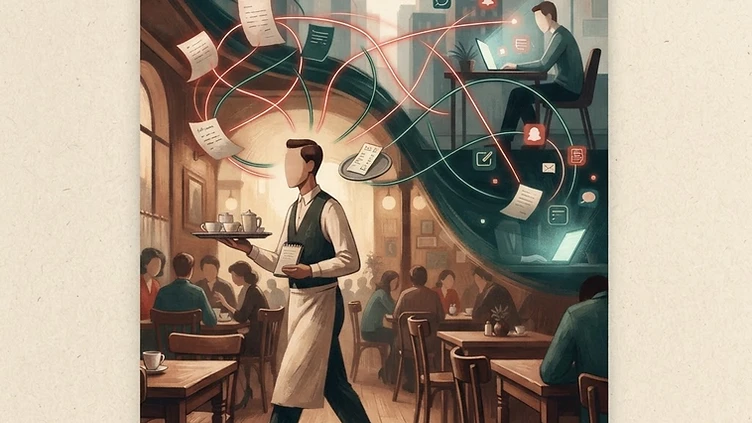
If a waiter at a restaurant can remember fifteen orders without taking a single note before reaching your table, this skill might seem familiar; because you too always have such small, unfinished tasks lingering in your mind. A half-written email, an unread message, an unanswered question... Why do these return so persistently, while hundreds of tasks we have completed are forgotten so silently? The answer to this question lies in a simple yet profound observation a Russian psychologist made while watching waiters in a cafe. That observation has now turned into one of the most insidious mechanisms by which the phone in our pocket keeps us in its grip. ## An Idea Born in a Cafe Bluma Zeigarnik, while sitting in a cafe in the 1920s, noticed something interesting about the behavior of the waiters: they remembered unpaid and unserved orders perfectly, yet they seemed to erase from their minds the tables where the bill had been paid and the job was finished. This observation led her to a simple question; does an incomplete task leave a stronger mark on memory than a completed one? Zeigarnik took this curiosity to the laboratory and confirmed her observation through experiments: people remember interrupted or incomplete tasks more clearly and for longer periods than the tasks they have finished. At first glance, this finding might seem like a mere memory quirk, but it actually reveals a much deeper principle regarding how the mind works. Our brain does not treat an unfinished action like a closed file, but rather like an open tab. Until that tab is closed, it continues to run in the background, consuming energy without us even realizing it. This simple cafe observation became one of the most cited principles of cognitive psychology in the following century; because this strange hunger of the human mind for completion can be seen not just at restaurant tables, but in every corner of life. ## The Mind's Unclosed Files So, what does this open tab actually do in the mind? What Zeigarnik points out is that an unfinished task does not simply act as a reminder, but rather persists as a source of low-level tension. This tension is sometimes felt so lightly that we do not even notice it; yet it remains in a corner of our attention like a small restlessness. Think of a book you left unfinished: the story does not end the moment you close the page, you continue to wonder what the character will do in the back of your mind. That curiosity is essentially nothing more than your brain whispering to itself that the job is not finished. The interesting aspect of this situation is that the tension is not directly proportional to the importance of the task. Even a very trivial task can occupy the mind as long as it remains incomplete. For example, you might have forgotten a simple message you needed to send to a friend, but the moment you remember you need to send it, that small thought returns every so often until the job is done, just like a pebble you forgot in your pocket. A counter-argument could be proposed here: perhaps we remember important tasks, not unimportant ones. But Zeigarnik's experiments show the exact opposite; the state of incompleteness, rather than importance, is the determining factor. The mind refuses to shelve anything labeled as not finished, regardless of its size. This can actually be read as a side effect of the human mind's pursuit of efficiency. Because our brain has a limited capacity for attention, it wants to put completed tasks aside to clear that capacity; but an unfinished task does not voluntarily relinquish that capacity by saying that it has not yet been closed. Thus, a memory mechanism emerges that remains constantly active even without conscious effort. This mechanism may be useful for survival in nature; after all, unhunted prey or an unfinished shelter are things that should not be forgotten. However, when the same mechanism is carried into a very different context of modern life, it transforms into an entirely different power. ## Open Loops Exploited by Notifications This is where the issue moves from cafes and books to the phone in our pocket. When the designers of digital platforms noticed this principle discovered by Zeigarnik, they did not leave it as a coincidental memory quirk; they turned it into a conscious trigger. That small red number on the unread message counter is actually a digital Zeigarnik mechanism whispering to you that you have an open file. What makes you feel that you must open that application until the number turns to zero is not the content of the message, but simply the state of being not yet closed. Having series end their episodes at critical moments is another version of the same logic. The story freezes at a moment of intense tension, the next episode is automatically queued, and you move on to the next one without even knowing exactly what it is you are curious about. There is a potential objection here: you might say that what calls us back to the screen is just curiosity and has nothing to do with the Zeigarnik Effect. But curiosity itself is essentially a derivative of incompleteness; what we do not know hangs in our minds as an unclosed question, and the next episode of the series draws us in with the promise of closing exactly that question. Social media applications take this mechanism even further; the infinite scroll feature presents a stream that never truly ends, constantly delaying the feeling of completion. The moment you want to finish reading a post and close it, the algorithm has already put the next one in front of you, so your mind never reaches a point where it can say it is finally closed. This can be thought of as a simultaneously and intentionally produced version of the tension experienced by Zeigarnik's waiters, scaled across millions of users. The waiters lived this tension without knowing it; today's platforms, however, produce this tension by knowing, measuring, and optimizing it. What this whole story tells us is perhaps this: our mind has a structure that refuses to forget what is unfinished, and while this structure was once a reflex that helped us survive, it has now become the most valuable raw material for systems trying to purchase our attention. Perhaps what we need to do is not to try to close every open loop immediately, but to distinguish which loops are truly important to us and which ones are designed solely to call us back to the screen. That small observation Zeigarnik made in the cafe still offers us one of the clearest mirrors today to question where and why our own attention is flowing.
İlgili Denemeler
Beyond Romance: Why Humans Fall in Love with AI Companions
Explore the psychological reasons behind falling for AI companions. A deep analysis of loneliness and digital connection in modern human relationships.
Parasocial Relationships: Why Do We Bond With Strangers?
Why do we feel close to people we have never met? Explore the psychological reasons behind parasocial relationships and how our brain processes these bonds.
Zeigarnik Effect: Why Does Our Mind Recall Unfinished Tasks?
A waiter's memory in a Berlin cafe became a psychological breakthrough that explains why our minds cling so tenaciously to tasks left incomplete.
Tartışma (0)
Henüz yorum yok. İlk yorumu siz yapın.
Join the Newsletter
New essays, once a week, delivered to your inbox.