Zeigarnik Effect: Why Does Our Mind Recall Unfinished Tasks?
A young psychologist studying the memory of waiters in a Berlin cafe discovered why the mind remains so fixated on the unfinished.
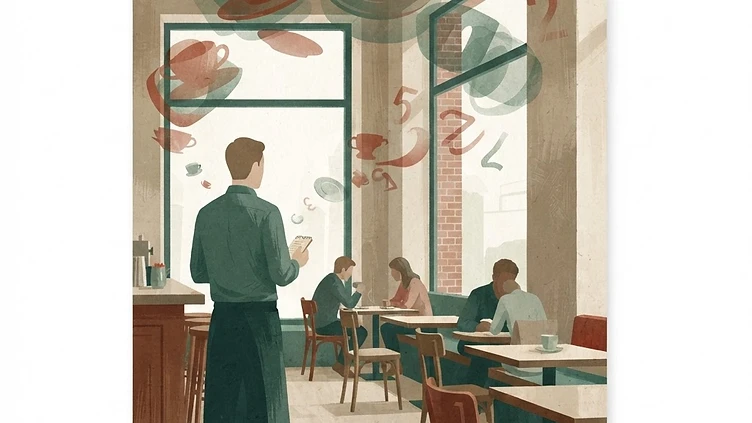
When you sit in a cafe and observe your surroundings, you notice a distinct rhythm in the movements of the waiters; as they pass from table to table, some orders linger in their minds while others vanish instantly. This ordinary observation turned into a curious question for a young psychologist in a small cafe on a busy Berlin street a century ago: why does the mind hold onto some things while forgetting others immediately? The order that erased itself from the waiter's memory once the bill was paid, contrasted with the unpaid bill that remained in mind for moments, if not days, was no mere coincidence; it was a doorway into one of the most fundamental principles of the human mind. The person who wondered what lay behind this door would discover an effect that still bears their name today. ## The Observation at the Cafe In 1920s Berlin, sitting in a bustling cafe, Bluma Zeigarnik observed the behavior of the waiters with curiosity. What caught her attention was their ability to remember customer orders and which plate went to which table without confusion; yet, this clarity lasted only until the bill was paid. As soon as the payment was made, the orders previously recited from memory would evaporate, and the waiter could no longer recall a table they had described with perfect precision a minute prior. Zeigarnik did not dismiss this as a chance detail; it was a small but striking window into how human memory clings to open tasks, and the desire to peer through that window never left her. At that time, Zeigarnik was part of a group of researchers working around Kurt Lewin, and she harbored a special interest in the minor quirks of the mind in daily life. This scene at the cafe was like a clue captured outside the laboratory; scientific curiosity manifesting in the most mundane corner of daily life. Although the question seemed simple on the surface, it was profound: why does the mind let go of a completed task so easily while holding onto an unfinished one so tightly? This question led her from the cafe to the laboratory and paved the way for the birth of a psychological concept. ## The Science of the Unfinished Zeigarnik tested her cafe observation by giving participants a series of small tasks; puzzles, simple organizational work, and short exercises. She allowed them to complete some of the tasks, while interrupting others before they were finished, directing the participant to a different activity. Afterward, she asked everyone which tasks they remembered better, and an interesting harmony emerged between the expected and the actual. The result was a pattern that confirmed and expanded upon the scene at the cafe. The result was not surprising, but it was definitive: interrupted tasks were remembered much more strongly and vividly than those that were completed. The mind closes a finished task like a door, but an unfinished task remains ajar like a window; a constant breeze blows through. This finding was later named after her and is known today as the Zeigarnik effect. What matters here is that forgetting is not a sign of laziness or apathy; on the contrary, the mind allocates its energy to unresolved tension, while safely filing away the completed. Thus, forgetting is not a deficit, but a form of mental economy. ## Remaining Unfinished in the Age of Notifications Today, the phone in our pocket is much like the bill pad of that Berlin cafe a century ago. An unread message, a red notification dot, dozens of tabs left open in a browser; they all sit in our minds like unpaid bills. Even if we turn off the phone, we know that little red dot is waiting for us somewhere, and this knowledge silently occupies a corner of our minds even in the calmest moments of the day. Just as the bill the waiter did not forget occupied a table, the bills we do not forget now occupy a screen; only the setting has changed. Some might object, arguing that remembering what is not forgotten is not a bad thing, but perhaps a sign of vigilance. But the difference here lies between attention and preoccupation. Zeigarnik's waiters made no conscious effort until the bill was settled; their minds spontaneously did not let go of an unresolved equation. Today, our minds do the same, only the scale has grown significantly; instead of a few tables in a cafe, we are overwhelmed by hundreds of small loose ends throughout the day, and each leaves a separate light burning in our consciousness. Perhaps this is why we feel so exhausted at the end of the day; the source of our fatigue is often not the work we have completed, but those little windows we left open, silently glowing in our minds. Reading an email halfway and closing it, leaving a book in the middle, interrupting a conversation with a promise to continue later; each opens a small ledger in our minds, and we carry a slight tension until that ledger is closed. What Zeigarnik noticed a century ago continues to multiply today, right in the palm of our hands and under our fingertips. Zeigarnik's ordinary afternoon at the cafe still tells us something today; the mind seeks peace not in completion, but in resolution. When the bill is paid, the waiter relaxes because their mind is no longer concerned with that table; we feel a similar sense of relief when we finish a task, a small but real comfort. But modern digital life makes it increasingly difficult to close the books, presenting us with three new open accounts for every one paid. Perhaps the real question is not how we can finish more tasks, but which bills we find worth paying and which ones we can knowingly leave open; for every loose end is as much a burden as it is, at times, a thread that keeps the mind alive.

İlgili Denemeler
Beyond Romance: Why Humans Fall in Love with AI Companions
Explore the psychological reasons behind falling for AI companions. A deep analysis of loneliness and digital connection in modern human relationships.
Zeigarnik Effect: Why Our Brain Hates Unfinished Tasks
The story of the Zeigarnik Effect, from waitstaff to digital notifications, explains why our minds struggle to forget the tasks we have left incomplete.
Parasocial Relationships: Why Do We Bond With Strangers?
Why do we feel close to people we have never met? Explore the psychological reasons behind parasocial relationships and how our brain processes these bonds.
Tartışma (0)
Henüz yorum yok. İlk yorumu siz yapın.
Join the Newsletter
New essays, once a week, delivered to your inbox.