The Ringelmann Effect: Why Individual Effort Fades
How did Max Ringelmann's 1913 rope-pulling experiment demonstrate why individuals silently retreat within a crowd?
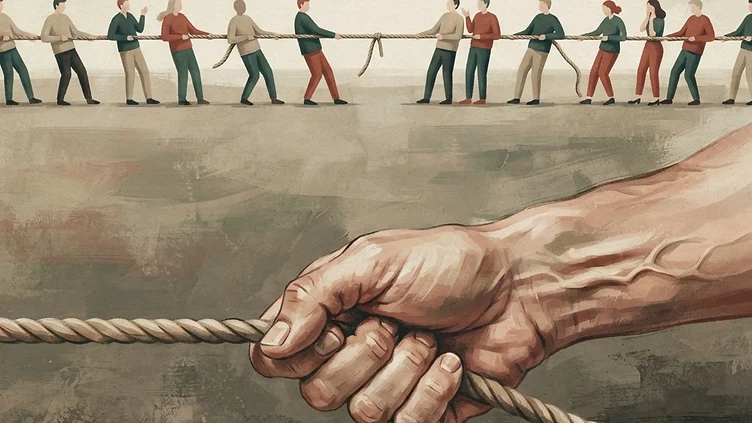
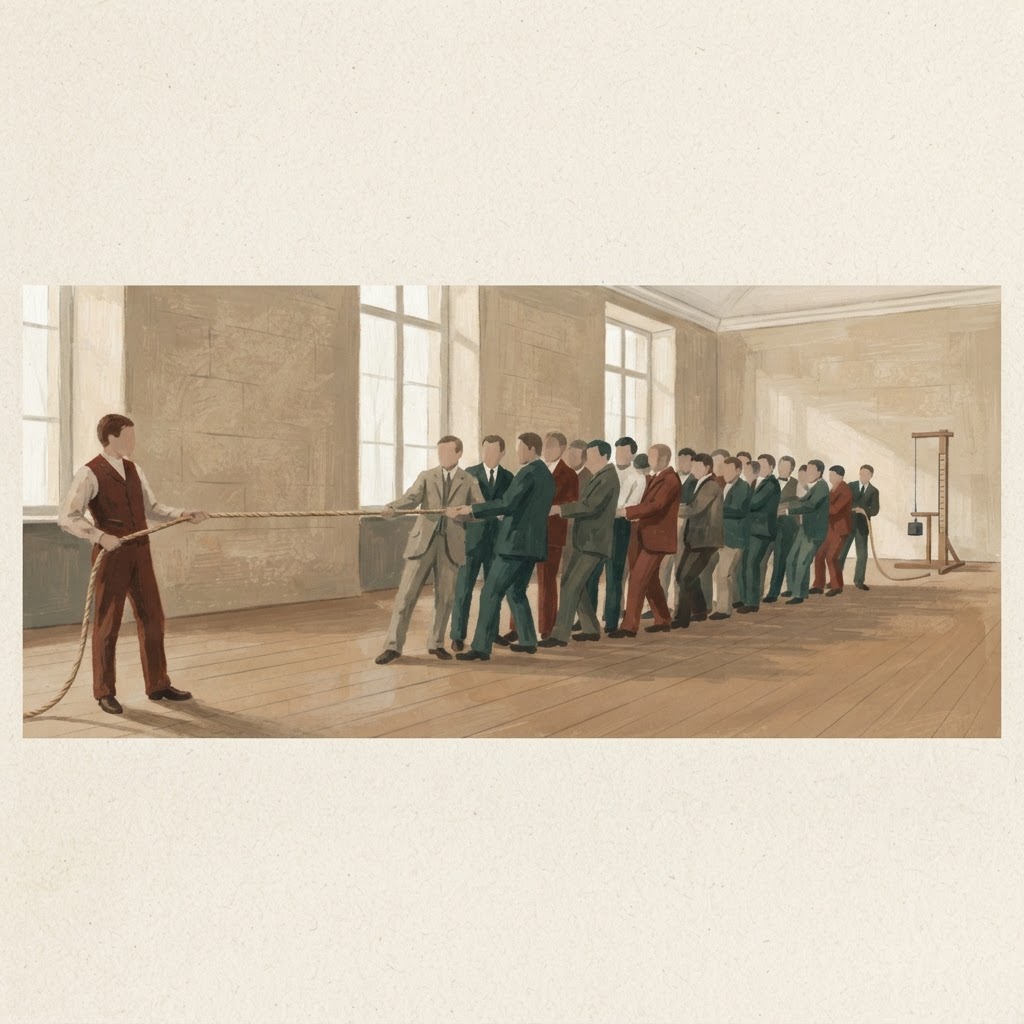
Have you ever noticed how, when ten people sit around a table, only a few are truly thinking while the rest merely nod? This question might sound like a modern office observation, but its roots reach back over a century to a French agricultural engineer having farmers pull ropes in a village square. In 1913, while trying to measure human power, Max Ringelmann revealed one of human nature's most insidious habits: the tendency to melt away silently into a crowd. His experiment helps us understand a pattern that repeats in every meeting room, every group project, and every shared responsibility today. Perhaps the real question is: are we pulling together, or are we just pretending to pull? ## The Numbers at the End of the Rope Ringelmann was not actually interested in the field of social psychology. As an agricultural engineer, he wanted to measure labor efficiency, and his tools were simple: a rope, a dynamometer, and volunteers from the village. He had individuals pull the rope alone, then in pairs, in groups of three, and in increasingly larger crowds. The expectation was simple: each new participant should have increased the total strength, and mathematically, it did. However, an unexpected crack emerged. As the group grew, the power exerted per person steadily decreased. Two people did not produce the sum of the power they could generate alone, and eight people performed far below expectations. Ringelmann first attributed this difference to measurement error, perhaps rope friction or individuals bumping into each other, but the numbers were so consistent that he realized he had to look beyond a physical explanation. Today, we call this the Ringelmann effect, a rare instance of terminology migrating from agricultural engineering to social psychology. Interestingly, Ringelmann discovered this not through conscious social observation, but through a purely practical question: how many workers should I hire on a farm, and how does yield change? The answer was that efficiency does not change arithmetically, but through a diminishing curve. As each new person joins the group, total power increases, but this increase grows smaller and smaller, as if an invisible hand at the other end of the rope is stealing a bit from each participant. That invisible hand is not a physical force, but a small calculation we keep about ourselves: if no one notices, I do not have to pull with all my might. ## The Comfort of Disappearing We must pause here and ask ourselves: why can this not be explained by physical fatigue? Because the issue is not muscle power, but visibility. When an individual pulls alone, every centimeter of progress belongs to them, as does every failure. But while holding a rope in a group of eight, no one can know exactly who is pulling how much. This uncertainty creates a strange relief in the human mind, as the anxiety of accountability only functions through observable effort. Where I am not seen, my effort does not exist in a sense, so I feel there is no cost to reducing it. This is not a malicious calculation; often, it is not even a conscious decision, but an ancient and insidious reflex of the human mind regarding energy conservation. One might argue that not everyone is an honest person, but most of us are not lazy either; we try to do our best. True, but what Ringelmann discovered is striking: slacking is not the default behavior of bad people, but of ordinary people within a crowd. When an individual is alone, the sole measure of their performance is themselves, but as the group grows, performance turns into a blur, and it becomes unclear who contributes what. It is precisely this blur that loosens the tie between effort and result. No one decides to be lazy; the moment they feel they will not be noticed, they allow their body and mind to relax a little. It is almost a physiological relief, much like our pace slowing down when we think no one is watching. ## The Ringelmann in the Meeting Room A century later, there is no rope, but groups are still pulling, just with an invisible one. A five-person team preparing a joint presentation, a group chat where everyone has access to the same file, a long email chain where everyone is copied but no one provides the real answer: these are all moments when responsibility per person becomes blurred. If there are ten people in a meeting and a decision needs to be made, usually two or three speak, and the rest nod silently. This silence does not stem from laziness, but from that familiar comfort of disappearing, as the person who does not speak also avoids the risk of expressing an incorrect idea. Digital tools often magnify this tendency rather than reducing it because, instead of making the contribution visible, they distribute it even further. While it is theoretically possible to track who wrote which paragraph in a shared document, in practice, no one follows this trail, so the document looks like a collective product, even though the actual labor usually comes from one or two people. The same applies to project management software; even if a task appears to be assigned to five people, one person usually finishes it, while others have a contribution share consisting merely of appearing in the list of names under the task. Because the system does not measure contribution individually, everyone appears to be pulling, but in reality, the true strength of the rope always comes from the same few hands. A counter-argument might come to mind: perhaps some tasks are not meant for one person, and group work produces real synergy, making it both impossible and unnecessary to isolate individual contribution. This is true, but Ringelmann's real warning is not against synergy, but against the use of synergy as a false cover. True teamwork is a structure where individual efforts empower one another, whereas slacking is a structure formed by the silent erasure of individual effort. The difference between the two lies in visibility: well-designed teamwork makes everyone's contribution traceable in some way, while poorly designed teamwork throws everyone into the same murky pool and never asks who is swimming how much. Ringelmann's rope may not be in our hands today, but the lesson he taught us remains within reach, being tested again in every group meeting, every joint project, and every shared task. The issue is not that people are malicious; it is recognizing how visibility shapes effort. The larger a group becomes, the harder it is to track individual effort, and this difficulty diminishes the effort itself. Perhaps the question we should ask is not how to shrink the crowd, but how to make every voice within the crowd audible. The rope is still there; only the hands holding the ends have changed. Yet, the old lesson of physics and human nature remains the same: if we want to increase strength, we must first see who is pulling.
İlgili Denemeler
Beyond Romance: Why Humans Fall in Love with AI Companions
Explore the psychological reasons behind falling for AI companions. A deep analysis of loneliness and digital connection in modern human relationships.
Zeigarnik Effect: Why Our Brain Hates Unfinished Tasks
The story of the Zeigarnik Effect, from waitstaff to digital notifications, explains why our minds struggle to forget the tasks we have left incomplete.
Parasocial Relationships: Why Do We Bond With Strangers?
Why do we feel close to people we have never met? Explore the psychological reasons behind parasocial relationships and how our brain processes these bonds.
Tartışma (0)
Henüz yorum yok. İlk yorumu siz yapın.
Join the Newsletter
New essays, once a week, delivered to your inbox.