The Invisible Gorilla: How Selective Attention Deceives
When our attention is locked onto a task, why are we unable to see even the most striking scene unfolding right before our eyes?
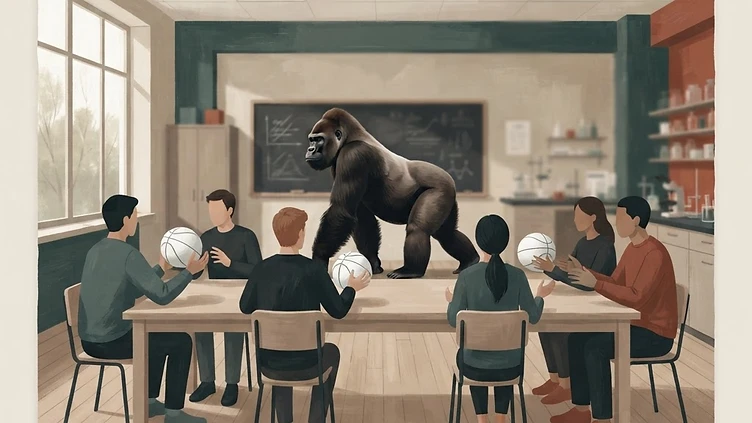
Imagine watching a video: two teams, one in white and one in black, are passing a basketball to each other. Your only task is to count the number of passes made by the team in white. Your eyes are on the screen, your mind is on the numbers; your attention is working exactly as requested. Then the video ends, you provide your count, and you are asked: "Did you see the gorilla, the ape, the man in the costume passing through?" In bewilderment, you ask, "What gorilla?" because you saw nothing of the sort. Yet, that person dressed as a gorilla walked right through the middle of the screen, even thumped their chest, and stood directly in front of the camera for several seconds. This is perhaps one of the most cited experiments in the psychology of attention, and it tells us something quite unsettling: that our eyes seeing something and our minds noticing it are not the same thing. ## Attention is a Spotlight Thinking of human attention as stage lighting is perhaps the most accurate metaphor for it. Our eyes are not a ceiling lamp illuminating a vast area with equal brightness simultaneously; they are a narrow-beam spotlight that selects a single point and focuses there. Everything that enters that light becomes sharp, emerges in detail, and settles into memory. But everything left outside that light, even if it is physically present on stage, is treated by the mind as if it never existed at all. This is exactly what happens in the gorilla experiment: the viewer's spotlight is locked onto the pass count, and the gorilla remains outside the beam. It is important to understand that this is not a matter of simple "absent-mindedness." In absent-mindedness, a person looks at something but their thoughts are elsewhere; here, the individual is truly looking at the screen, eyes open, mind alert, and indeed highly focused on the task. The problem is not that the eye does not see, but that seeing does not translate into noticing. Our brain can process only a small fraction of the visual information raining down on us every second; the rest slips away as if it were never recorded. This is not an evolutionary flaw, but rather a necessity: if we tried to process every detail with the same intensity, we could not keep track of even a single pass count. But this necessity comes at a cost, and that cost is sometimes a gorilla passing by without being noticed. ## New Gorillas in the Age of Screens Today, we all perform a much more persistent version of that pass-counting task from the laboratory video every day: the screen in our hands. The phone acts like a spotlight thief, constantly calling our attention to itself with instant notifications, feeds, and messages. While walking, waiting for a bus, or even sitting at the same table with a friend, we direct our light to the screen; everything else ceases to exist for us in that moment. A cyclist crossing the street in traffic, a child stopping suddenly on the sidewalk, or even a pothole on the path we are walking, could be as visible as the gorilla in that experiment; but as long as our attention is locked onto the screen, seeing it is not about it being there, but about what we choose to look at. There is a more subtle, more sorrowful version of this situation: the face of the person across from us. Checking our phone while talking to someone may seem like "just a second," but in that second, the unease, the joy, or the unspoken thought flickering across the other person's face vanishes, just like the gorilla left outside our light. What is interesting here is that we do not do this with ill intent; just as the participants in the experiment held no malice regarding the gorilla, we are simply focused on our task—the flow on the screen. But the result is the same: it was there, it passed before our eyes, and we did not see it. ## The Fallacy of Being Sure That I See The most striking aspect of this experiment is perhaps not our failure regarding the gorilla, but our inability to predict that failure. Most people who hear about the experiment say, "I would have noticed"; they believe with almost unshakable confidence that their own attention is stronger, more open, and more inclusive. Yet the experiment shows time and again that this confidence is not the product of a real ability, but a cognitive illusion. Because the human mind cannot observe its own process of seeing, it cannot even be aware of what it does not see; thus, the claim that "I see everything" remains an untested assertion. The real danger of this fallacy is that it makes us reckless. If I knew that my attention was limited, perhaps I would pause for a moment before stepping into traffic while looking at my phone, or think twice before reaching for the screen while talking. But the belief that "I notice everything anyway" renders these small pauses unnecessary; as it turns out, the moments when I am most confident are exactly the moments when I am least likely to notice. Moreover, this fallacy is not unique to ordinary people; even those who know the experiment and have studied the psychology of attention cannot help but harbor the same confidence when their own lives are at stake. It is as if knowledge, in this regard, strangely fails to turn into experience. Perhaps that is why the experiment remains more than just a laboratory curiosity; it functions as a mirror. Every time we tell ourselves, "I see everything," we hear a call reminding us how little we actually see; but with a strange irony, we mostly ignore that call as well. Because seeing our own limits is as difficult as noticing something outside our own attention; perhaps that is why we neglect to turn and look at ourselves even in the moments we need it most. What the gorilla experiment leaves us with is actually not a critique, but an invitation. Accepting that our attention is a narrow beam of light makes it possible for us to make more conscious choices about where we shine that light. When we give up the claim that we can see everything at once, perhaps we start asking, for the first time, where we really want to look. None of us can know how many gorillas have passed before our eyes; but being able to stop for a moment from now on and ask, "Where is my light right now?" may be the most modest and real freedom we possess.
İlgili Denemeler
Beyond Romance: Why Humans Fall in Love with AI Companions
Explore the psychological reasons behind falling for AI companions. A deep analysis of loneliness and digital connection in modern human relationships.
Zeigarnik Effect: Why Our Brain Hates Unfinished Tasks
The story of the Zeigarnik Effect, from waitstaff to digital notifications, explains why our minds struggle to forget the tasks we have left incomplete.
Parasocial Relationships: Why Do We Bond With Strangers?
Why do we feel close to people we have never met? Explore the psychological reasons behind parasocial relationships and how our brain processes these bonds.
Tartışma (0)
Henüz yorum yok. İlk yorumu siz yapın.
Join the Newsletter
New essays, once a week, delivered to your inbox.