Solastalgia: The Psychology of Losing Home Without Moving
How can one become rootless without ever leaving their home?
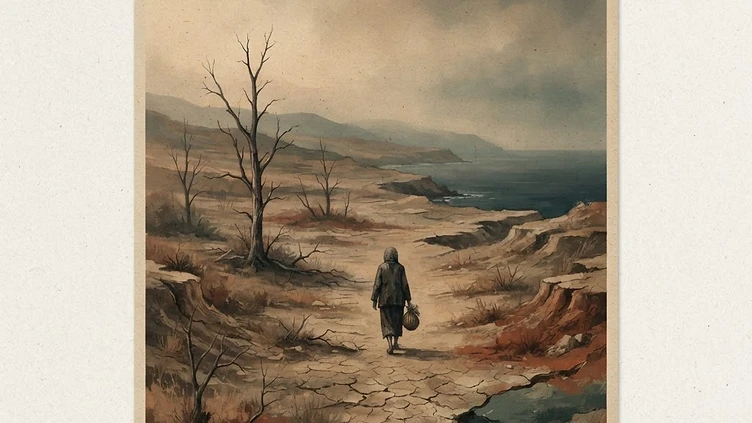
Have you ever looked out your window one morning and found that you could not recognize the place? The street is the same, the trees are identical, yet something is missing; or perhaps, there is something extra. You never left home, you never packed a suitcase, and you never waved goodbye to anyone at a station. Yet, there is a migration within you, silent and inexplicable. This strange feeling now has a name: solastalgialgia. It is the story of becoming homeless without moving, of standing with your roots while failing to recognize the soil where your body grew. And this story is the story of more people than we might imagine. ## A Philosopher Discovers a Void Glenn Albrecht, an Australian philosopher, realized while listening to people living in regions devastated by mining that existing words did not capture their experiences. These people had not left their homes, but every morning when they woke up, the landscape around them looked a little more degraded, a little more alien. The land was no longer the same; the trees on it had been felled, the rivers polluted, and the hills hollowed out. Albrecht understood that the pain these people described was neither simple sadness nor a known type of grief; there was a void in language, and this void belittled and rendered the lived experience invisible. Can we say that the lack of a word is, in effect, a denial of an experience? Albrecht's intuition was fueled precisely by this: an unnamed emotion is often a socially non-existent one. Therefore, the philosopher coined the term solastalgia by combining a Latin root meaning solace with the word nostalgia. The word itself carries a contradiction; it is a nostalgia that seeks solace but finds none. Because in classic nostalgia, the longed-for place remains somewhere, alive in the imagination; in solastalgia, the place being yearned for changes and disappears right in front of one's eyes. ## Exile Without Being Exiled What we call gurbet in Turkish is fundamentally a relationship of distance. A person leaves home, moves away, and then misses what they left behind. Even if this longing causes pain, it is a familiar pain; it has a name, songs, and letters. But solastalgia reverses this schema. A person stays put, goes nowhere; it is only their surroundings that transform into something else around them. A villager might remember the stream where they spent their childhood; the stream is still there, but it has dried up, or been covered in concrete, or taken on a different color. The villager has not migrated anywhere, but the stream feels as if it has migrated away from them. Here, one might ask: why should such a small change trigger such a deep sense of grief? Perhaps the issue lies not in the magnitude of the change, but in its unexpectedness and irreversibility. When a person moves, they know the loss in advance, they prepare, and they weave the grieving process into a kind of ritual. In solastalgia, however, the loss arrives insidiously, accumulating day by day, unnoticed; one morning, a person looks at their own home with the eyes of a stranger and cannot recognize it. Moreover, this grief has no funeral, no closing ceremony; the environment does not truly die, it just becomes something else. Mourning something that has transformed is a much more complex task than mourning something that has died, because the thing to be mourned still stands before your eyes—it is simply no longer what it once was. ## A Shared Emotion of the Climate Era Once, this feeling might have seemed like the exclusive experience of small communities living in mining regions. But climate change is turning this specific experience into a shared destiny. Drying lakes, seas eroding coastlines, winters where we once expected snow now passing with rain; these all produce small moments of solastalgia. Nobody is packing a suitcase in the midst of these changes, yet everyone is being displaced in a way; they are being displaced without moving. Perhaps this is why solastalgia is no longer an exception, but a mood quietly spreading. The indescribable distress that arises in us after reading climate reports may, in fact, be a small flicker of this emotion. One could argue that throughout human history, we have always lived in a constantly changing environment, and each generation has adapted to its own changes. But the speed of change today seems to exceed the adaptive capacity of previous generations; for a landscape, a forest, or a climate to become unrecognizable within a single human lifetime directly conflicts with the human need for rootedness. And this conflict is no longer just a problem of a distant region; it is an unease that permeates everyone's daily life. Then we can ask: is rootlessness no longer just the destiny of the immigrant, the exile, or the refugee? Perhaps we are all experiencing a kind of silent exile without moving from our place; our environment is leaving us, before we have even left it. What solastalgia teaches us is that perhaps grief does not always begin with a departure; sometimes, we can fall into a deep sense of loss without ever leaving at all. Naming this feeling does not solve it, of course, but at least it makes it visible; and something visible becomes something that can be shared, discussed, and perhaps, one day, overcome.
İlgili Denemeler
Beyond Romance: Why Humans Fall in Love with AI Companions
Explore the psychological reasons behind falling for AI companions. A deep analysis of loneliness and digital connection in modern human relationships.
Zeigarnik Effect: Why Our Brain Hates Unfinished Tasks
The story of the Zeigarnik Effect, from waitstaff to digital notifications, explains why our minds struggle to forget the tasks we have left incomplete.
Parasocial Relationships: Why Do We Bond With Strangers?
Why do we feel close to people we have never met? Explore the psychological reasons behind parasocial relationships and how our brain processes these bonds.
Tartışma (0)
Henüz yorum yok. İlk yorumu siz yapın.
Join the Newsletter
New essays, once a week, delivered to your inbox.