Phantom Vibration Syndrome: Is Your Phone Part of You?
Why do we feel our phone vibrating when it is not?
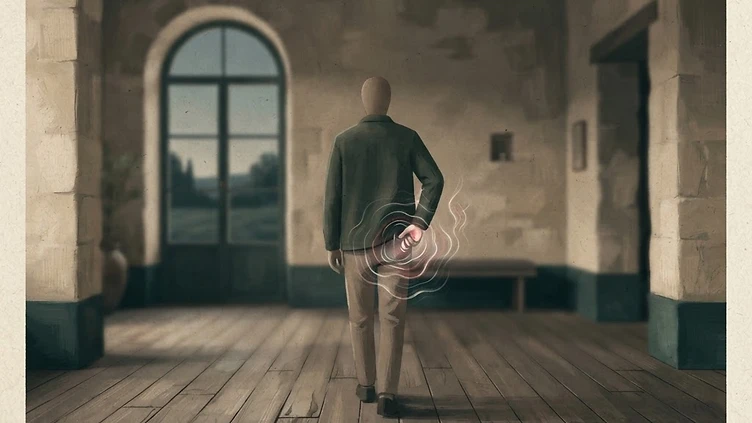
Your phone is in your pocket, silent, screen off, its vibration motor perfectly still. Yet, you feel that familiar shiver in your leg, you reach into your pocket, check the screen, and see nothing there. This moment repeats not once, but perhaps ten times a day, and with every instance, we ask ourselves: Why does the body believe in a signal that does not exist? Perhaps that is not the real question; perhaps the real question is whether the phone has now become a part of the body. The phantom vibration sensation is the first and most striking clue for anyone searching for the answer to this question. ## The Digital Twin of a Phantom Limb In medical literature, a phantom limb is the phenomenon where a severed arm or leg continues to exist on the brain map. The nervous system cannot accept the loss of an organ that is no longer there, so it continues to produce signals, and the person feels an itching, aching, or even moving limb. Our relationship with our phone functions on a similar logic; the difference is that instead of a lost organ, there is an acquired extension. The brain begins to map this object, which sits in the same pocket for days and is carried with the same weight, as an extension of the body, and it feels its absence just as it feels its presence. Imagine you are expecting important news from a friend. Your mind is waiting for that message, and your body joins in the wait, ready to interpret the slightest movement of the fabric in your pocket as a vibration. What is interesting here is that this illusion does not appear randomly, but precisely when expectations are high. It seems the body does not just carry the phone physically; it also adopts it psychologically. While the phantom of a severed limb reminds us of itself with pain, the phantom of the digital twin in our pocket warns us with a slight shiver, almost politely. One might object to this analogy; after all, a phone was never a part of the body, only a carried object. But we know the brain makes no such distinction. For the brain, what matters is not that an object is anatomically stitched to the body, but that it is engraved on the map through repeated attention and dependence. The phone was not added through a surgical operation, but through years of habit, it has redrawn the boundaries of the body. Although not as dramatic as a phantom limb, this sensation relies on the same root and the same logic of the brain. ## The Body's New Reflex When we talk about classical conditioning, the example of Pavlov’s dog drooling at the sound of a bell comes to mind; when a stimulus is paired with a result repeatedly, the body begins to expect the result even when the stimulus arrives alone. Our relationship with our phone follows this exactually. pattern. The vibration first becomes a herald of a message, a notification, or attention; then, this pairing repeats so often that the body begins to produce the sensation of vibration even before the vibration itself. A nervous system that gets excited before a notification arrives or feels uncomfortable when there is no message is actuall.lyy. the most natural result of this conditioning. The truly striking thing here is that we do not need to make a conscious effort to achieve this reflex. No one sits down and says, I am going to condition myself to my phone; the habit forms spontaneously through the quiet accumulation of daily use. Small repetitions, such as checking the screen upon waking, checking the pocket during a meeting, or knowing the phone's location even at the dinner table, leave a deep mark on the nervous system over time. Phantom vibration is nothing more than this mark surfacing; the body continues to stage the learned reflex even when the stimulus is absent. Some might say this is not conditioning but a simple symptom of anxiety; that is, the issue is not getting used to the phone, but the fear of missing out. This objection is partially correct, as anxiety strengthens this feeling. But anxiety.tself is actually a product of conditioning; if we were not so accustomed to being rewarded with notifications, we would not be so restless in their absence. Anxiety and reflex stand here as two sides of the same coin, feeding off one another. ## The Colonization of Attention To see phantom vibration merely as a physical illusion is to miss the most interesting part of the issue. This sensation is actually physical evidence of how our minds remain on guard with the constant expectation of notifications. Our attention is no longer something that naturally drifts and gathers; it has become a state of vigil, set with a near-military discipline, waiting at any moment for a call, a message, or an alert. Because the phone is the symbol of this vigil, even its silence disturbs the mind, because silence is an unexpected situation. You can notice this during a meeting; while someone is talking, your hand goes into your pocket, you do not take the phone out, but you feel the need to verify its presence. This small movement is a sign that our attention no longer belongs entirely to us. A corner of our mind is always reserved for a potential notification waiting behind a screen somewhere. Phantom vibration is nothing more than this reserved corner continuing to work even when it is left empty; attention seems to have established a colony of its own, and we are now living like the colony of that colony. It is easy to think of this situation as an individual weakness, but that is misleading. The issue is not just a lack of personal will; it is that notifications, applications, and screens are designed to constantly feed this state of alert. While our attention is being colonized, an architecture that makes this colonization possible is growing around us. Phantom vibration is the smallest but most honest mark this architecture leaves on our bodies; no advertisement, no marketing phrase tells us as clearly how dependent we are. Perhaps this feeling will never disappear completely, because the conditions that give birth to it are not disappearing either. As long as the phone remains in our pocket, the body will continue to map it, and the mind will continue to wait for it. But at least becoming aware of this illusion allows us to see it not just as a strange bodily quirk, but as a mirror of a relationship. The phantom limb in our pocket is perhaps the quietest yet most persistent witness, reminding us of how deep, and how physical, a bond we have formed with technology.

İlgili Denemeler
Beyond Romance: Why Humans Fall in Love with AI Companions
Explore the psychological reasons behind falling for AI companions. A deep analysis of loneliness and digital connection in modern human relationships.
Zeigarnik Effect: Why Our Brain Hates Unfinished Tasks
The story of the Zeigarnik Effect, from waitstaff to digital notifications, explains why our minds struggle to forget the tasks we have left incomplete.
Parasocial Relationships: Why Do We Bond With Strangers?
Why do we feel close to people we have never met? Explore the psychological reasons behind parasocial relationships and how our brain processes these bonds.
Tartışma (0)
Henüz yorum yok. İlk yorumu siz yapın.
Join the Newsletter
New essays, once a week, delivered to your inbox.