Sight & Sound Poll: Can We Rank The Best Film?
For seventy years, a different film has answered the same question every decade, but is this shifting choice truly a sign of progress?
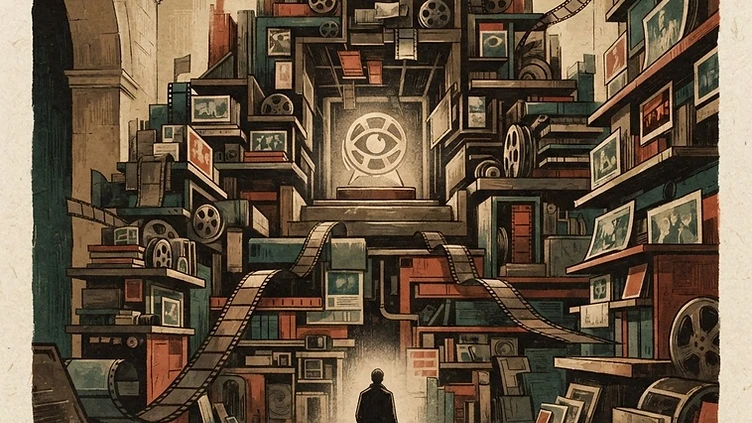
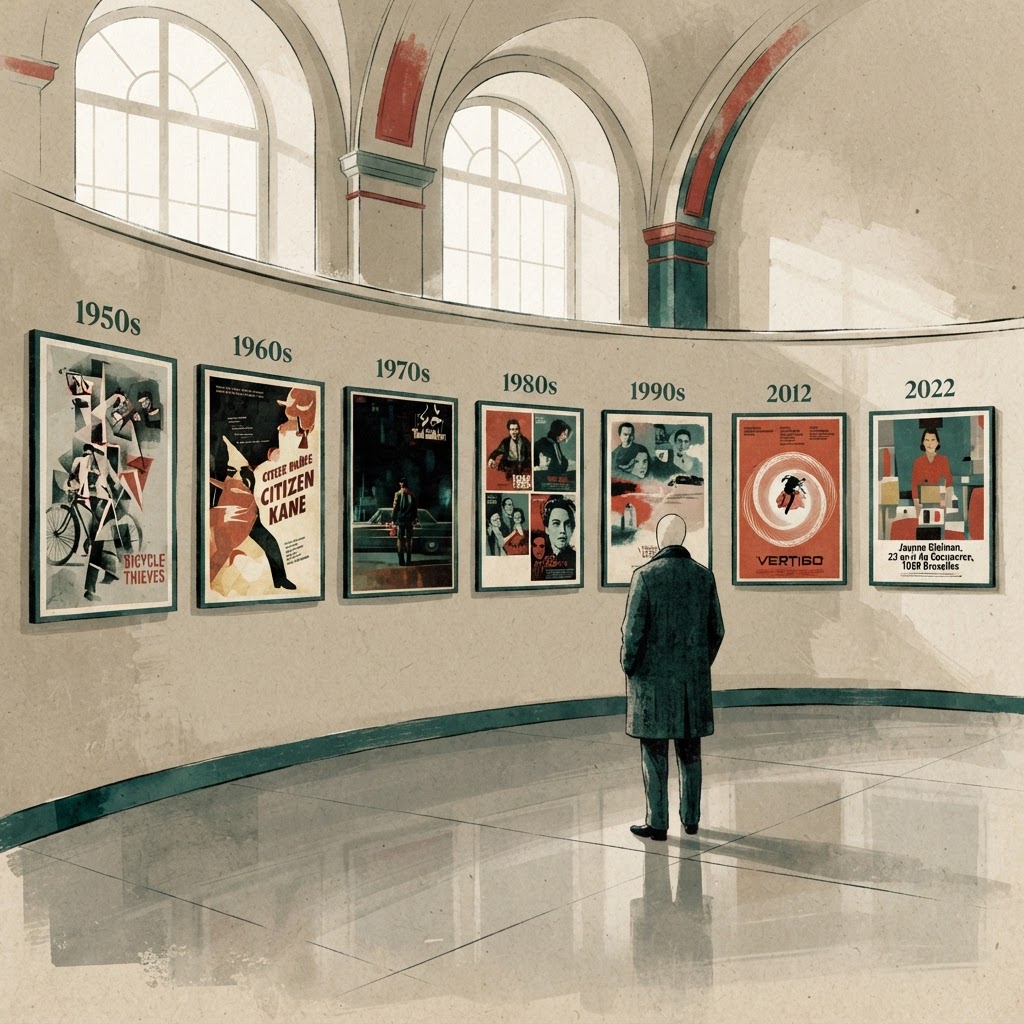
The Sight and Sound poll has spanned over seventy years, with critics and directors from across the globe facing the same question every decade: What is the greatest film in the history of cinema? The question remains unchanged, yet the answer shifts every time, as if people climbing to the peak of the same mountain are met with a different vista on each ascent. This recurring transformation has always led me to wonder: are we witnessing genuine progress, or are we merely gazing at ourselves in the mirror of our own time and declaring it the pinnacle of cinema? To pursue this question is to recognize how fragile aesthetic judgment truly is, and how deeply it is tied to time and power. ## Who Votes, What Is Chosen? The most overlooked detail of the poll is that critics and directors cast two separate sets of votes. While film writers vote on one list, those who make the films express their preferences on a different ground, and these two groups rarely push the same title to the summit. To a director, technical daring or a break in narrative structure may stand out, whereas to a critic, the cultural resonance or formal innovation of a film is often the deciding factor. In other words, two groups of people looking at the same cinematic history emerge with completely different films, filtered through their own professional perspectives. This distinction shows me that what we call the greatest film is not an objective reality that yields the same result for everyone, like a laboratory measurement, but rather a construction shaped by one's point of view. Just as evaluating a bridge from the eyes of an engineer versus a pedestrian yields different results, looking at cinema through the eyes of a creator versus an observer produces different peaks. One might argue that this difference is not a weakness but a testament to the richness of cinema. I agree, yet this very richness reminds us that the idea of a single greatest film is built on shaky ground from the start. ## The Fall of a Fifty-Year Throne The fact that Citizen Kane held the top spot in this poll so unwaveringly for decades seemed to prove how stable the writing of film history appeared to be. For years, the film became an almost untouchable point of reference, a benchmark; even young critics accepted it without question because previous generations had already agreed upon it. However, in 2012, this throne passed to Vertigo in an unexpected turn, and this change created both astonishment and a sense of relief in cinematic circles, as if everyone had been waiting for this shift but were afraid to say so. The true significance of this overthrow lies not in which film is better, but in why it changed. Hitchcock's film did not suddenly become more perfect; rather, the change occurred because the viewing generation found its own anxieties, its own psychoanalytic and formal curiosities, more strongly reflected in that film. A counterargument arises here: perhaps the rise of Vertigo was simply the recognition of a depth that had gone unnoticed before—a development, an evolution. But even this argument is inherently contradictory, for if a film's value can be overlooked for fifty years, how can we claim that aesthetic judgment captures a fixed truth? Taste is merely a consensus passed down from generation to generation, as fragile and fleeting as any other consensus. ## The Question Raised by the Rise of Jeanne Dielman The fact that Chantal Akerman's Jeanne Dielman, 23 Quai du Commerce, 1080 Bruxelles took the top spot in the 2022 poll meant that for the first time in the list's seventy-year history, a female director had reached this position. When this news broke, some circles welcomed it as the long-overdue manifestation of deferred justice, while others claimed the list had finally surrendered to identity politics rather than aesthetics. Both express a valid concern from their perspective, but both share the same blind spot: they forget that the list was never purely about aesthetics. I believe the rise of Jeanne Dielman is not a scandal, but a candid confession of the poll's nature. If a film can be absent from lists for forty years and suddenly leap to the top, it does not mean the film itself has changed, but that the composition, interests, and priorities of the voters have shifted. The cinematic canon is not a frozen sculpture in a museum, but a map that is constantly changing hands, with each generation defining its own borders and declaring its own capital. This shows us that the canon is essentially a matter of power; who votes, who is visible, and who is forgotten determines the shape of the list, with aesthetic judgment acting as a cloak draped over these power dynamics after the fact. Looking at all these changes, one cannot help but ask: perhaps the question we are asking is fundamentally flawed from the start. Seeking the greatest film in history is an effort to find a constant that never existed, a habit of rewriting the same title every decade without ever being satisfied. Perhaps the value of the poll lies not in providing an answer, but in taking that answer away from us each time and showing us the face of our own era. The toppling of Citizen Kane by Vertigo, and Vertigo by Jeanne Dielman, does not tell us what the greatest film is, but rather forces us to re-examine who we are every decade. Perhaps the question itself never changes, but the answer writes its own small history.
İlgili Denemeler
The Derivative of Love: The Mathematics of the Problem Called Human
Alpay begins with the closest point of reference. Man and woman, an equation with two unknowns. Former lovers, a closed set. Marriage, a parenthesis opening into eternity. These are not mere literary flourishes, but a way of reading: when the same event is told in a different language, it suddenly becomes visible.
A Civilization That Postpones Its Hopes to the Hereafter
We are traversing one of the most peculiar eras in human history. On one hand, we speak of colonizing Mars, establishing life on other planets, extending human longevity, conquering diseases, and developing machines capable of cognition. On the other hand, we remain profoundly uncertain as to whether we can leave behind a habitable world for one another.
Why Did Aliens Choose Earth? Is There Nowhere Else Left?
This essay explores why humans instinctively frame technical glitches as alien invasions, revealing our collective need to feel significant in a vast universe.
Tartışma (0)
Henüz yorum yok. İlk yorumu siz yapın.
Join the Newsletter
New essays, once a week, delivered to your inbox.